

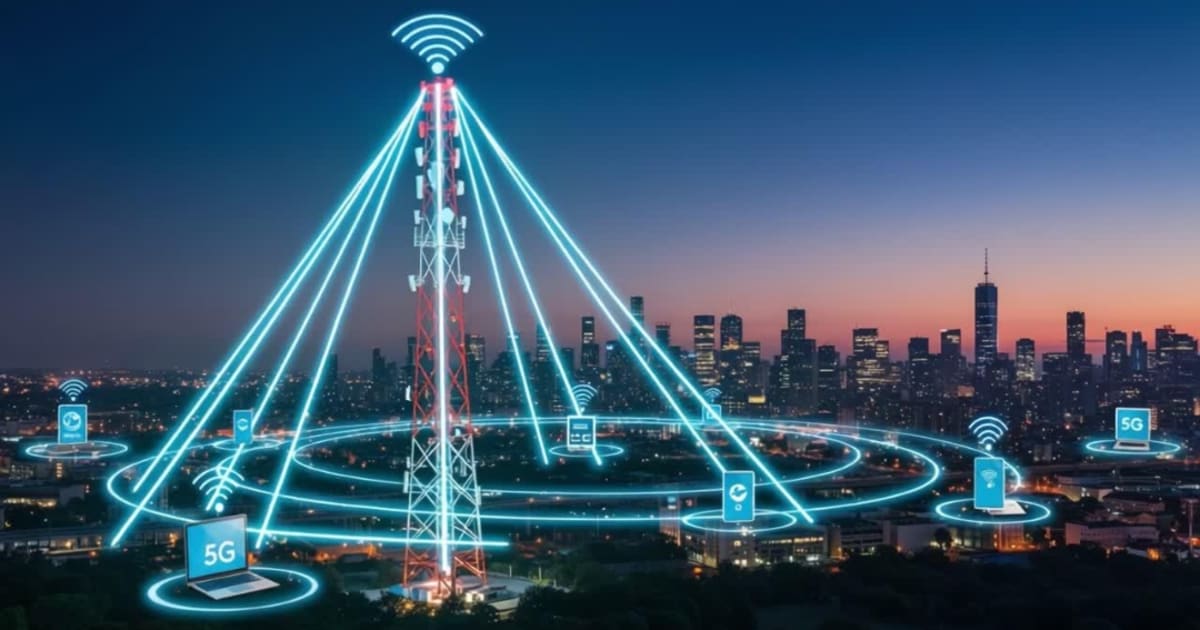
Bharti Airtel spent the last decade doing what every telecom company had to do—building one of India's largest digital networks. Between spectrum purchases, fibre deployment, 4G expansion and the nationwide rollout of 5G, the company invested nearly ₹3.3 lakh crore in building digital infrastructure. Those investments helped Airtel become India's second-largest telecom operator, serving hundreds of millions of customers across mobile, broadband and enterprise connectivity.
Now Chairman Sunil Bharti Mittal believes the next phase of growth lies elsewhere.
Instead of focusing solely on adding telecom subscribers, Airtel is preparing to monetise the digital infrastructure it has already built through three high-growth businesses:
Airtel Money (NBFC)
Enterprise Cloud Services
Nxtra Data Centres
The shift reflects a fundamental transformation in the telecom industry. Globally, operators are evolving into digital infrastructure companies, using their networks as platforms to deliver financial services, enterprise technology and artificial intelligence infrastructure.
For Airtel, connectivity is no longer the destination. It has become the foundation upon which entirely new businesses are being built.
Telecom Has Become A Mature Business
The Indian telecom market today looks very different from what it did ten years ago. Subscriber growth has slowed because mobile penetration is already among the highest in the world. As a result, telecom operators have fewer opportunities to expand simply by adding new users. Future earnings increasingly depend on:
Higher Average Revenue Per User (ARPU)
Premium 5G adoption
Fibre broadband
Enterprise connectivity
Digital services
Even though tariff hikes and 5G upgrades can continue to improve profitability, telecom alone is unlikely to deliver the high growth rates investors expect over the next decade.
This explains why leading global operators—including Verizon, AT&T, Singtel and Deutsche Telekom—are investing aggressively in enterprise technology, cybersecurity, cloud computing and financial services. Airtel is following a similar path.
Airtel Money Could Become Airtel's Highest-Margin Business
Perhaps the biggest strategic change is taking place in financial services. Many investors continue to associate Airtel's financial business with Airtel Payments Bank. However, Airtel's long-term lending ambitions are centred on Airtel Money, which operates under an NBFC (Non-Banking Financial Company) framework.
The distinction is important.
A payments bank can facilitate deposits, payments, remittances and UPI transactions but cannot lend because of RBI regulations.
An NBFC, on the other hand, can build a lending business.
That dramatically changes the economics.
Through Airtel Money, the company can expand into Personal loans, Consumer finance, Merchant lending, Device financing, Working capital loans, Embedded finance, Buy Now, Pay Later (BNPL) and Co-lending partnerships.
Instead of generating small transaction fees from payments, Airtel can earn significantly higher income through interest spreads, lending fees and financial product distribution.
The company also possesses one of its biggest competitive advantages—a subscriber base of more than 400 million mobile customers. Using the Airtel Thanks ecosystem, customer relationships, payment behaviour and digital engagement, Airtel can distribute financial products at a far lower customer acquisition cost than many standalone fintech companies.
If executed well, Airtel Money could evolve into one of the company's most profitable businesses over the coming decade.
Cloud Computing Is Becoming Airtel's Enterprise Growth Engine
Artificial intelligence is changing how businesses consume technology. Instead of buying expensive servers and maintaining their own IT infrastructure, companies are increasingly shifting workloads to cloud platforms. This transformation is creating a massive opportunity for Airtel Business. Its enterprise portfolio includes:
Hybrid cloud solutions
Managed cloud infrastructure
Enterprise networking
Cybersecurity
Edge computing
Digital transformation services
AI-ready enterprise platforms
Unlike Amazon Web Services, Microsoft Azure and Google Cloud, Airtel is not attempting to become a global hyperscaler.
Instead, it is positioning itself as an integrated enterprise technology partner capable of combining connectivity, cloud infrastructure, cybersecurity and managed services under one ecosystem.
For Indian businesses beginning their AI adoption journey, this integrated model could prove particularly attractive.
Nxtra Could Become Airtel's Crown Jewel
If there is one business that could redefine Airtel over the next decade, it may be Nxtra by Airtel.
Artificial intelligence has triggered an unprecedented surge in demand for data centres.
Training large AI models requires thousands of GPUs operating inside hyperscale computing facilities that consume enormous amounts of electricity while maintaining near-perfect uptime.
This has transformed data centres from real estate assets into critical digital infrastructure. Nxtra is expanding rapidly to serve demand from Cloud providers, AI companies, Banks, Government agencies, E-commerce platforms, OTT companies, Healthcare and Manufacturing.
Unlike traditional telecom towers that connect people, data centres connect the digital economy itself. Every AI application, cloud service, online payment, video stream and enterprise software platform ultimately depends on computing infrastructure.
As India's AI ecosystem expands, demand for domestic hyperscale data centres is expected to grow significantly, placing Nxtra in one of the fastest-growing segments of digital infrastructure.

Risks Investors Should Watch
Despite the significant opportunity, execution will be critical. Key challenges include:
Competition from global cloud providers.
Credit risk within the NBFC business.
High capital expenditure for data centres.
AI infrastructure costs.
Electricity availability.
Cybersecurity threats.
Regulatory oversight in financial services.
Airtel's ability to balance aggressive expansion with capital discipline will determine how successful this transformation ultimately becomes.
The Bottom Line
Bharti Airtel is no longer positioning itself simply as India's second-largest telecom operator.
It is steadily transforming into a digital infrastructure company.
The telecom network that Airtel spent decades building is now becoming the platform for a much broader ecosystem spanning enterprise cloud services, AI-ready data centres and financial services through Airtel Money.
If this strategy succeeds, the company's future earnings may be driven less by voice calls and mobile data packs and more by lending, enterprise technology, artificial intelligence and digital infrastructure.
For investors, that changes the investment thesis entirely.
The next chapter of Airtel's growth may not be written in the telecom sector alone—it could be shaped by the convergence of finance, cloud computing and AI infrastructure, positioning the company at the centre of India's digital economy for the next decade.