47% of India's UPI Traffic, 650 Million Users, and a $9-10 Billion Valuation That Still Has Wall Street Asking One Question

In February 2026, PhonePe processed 9.3 billion transactions worth approximately ₹13.1 trillion in a single month. That is nearly half of India's entire UPI ecosystem — a payments network that, across all players combined, processes over 21 billion transactions monthly. The numbers are extraordinary by any measure, and yet they have not been enough to get PhonePe across the listing line.
The company filed its IPO prospectus in September 2025, targeted a listing by April 2026, and then — with escalating geopolitical tensions in the Middle East rattling global markets and the Nifty falling 9% in a single month — paused the process entirely in March 2026. CEO Sameer Nigam said the decision was purely market-driven. The company's spokesperson was emphatic that valuation concerns were "baseless" and that PhonePe remained "committed to going public once market conditions improve."
The public markets are now settling. The IPO window may reopen. And when it does, the question that drove the original valuation debate will still be sitting there, unanswered: in a country where the payments infrastructure generates almost no direct revenue because government policy forbids transaction fees, what is the right multiple for a company whose core product is effectively free to run?
THE VALUATION JOURNEY: FROM $12 BILLION TO $9-10 BILLION
In 2023, General Atlantic led a $100 million funding round valuing PhonePe at $12 billion — a number that reflected peak fintech enthusiasm and investor conviction that financial services revenue from insurance, mutual funds, and lending would eventually justify payments-scale distribution at premium multiples.
By early 2026, the IPO targeting range had been revised down to $9–10.5 billion. The lower end represents a 25% discount to the 2023 private round — a substantial markdown that reflects both changed market conditions and a more sober investor assessment of the monetisation timeline. Walmart plans to sell approximately 9-12% of its stake through the OFS. Tiger Global and Microsoft are fully exiting. No fresh capital is being raised — every rupee of IPO proceeds flows to existing investors, not to the business.
That pure-OFS structure is the detail that most shapes how public market investors should think about this listing. When the world's largest retailer and two major institutional investors are all selling, but the company itself is not raising capital, it tells you something specific: the investors who built this business believe the valuation today is an acceptable exit, and they would rather take liquidity now than hold for further appreciation. That is not a signal of distress — but it is not a signal of extraordinary confidence in near-term value creation either.
THE CORE BUSINESS: DOMINANT PAYMENTS, THIN REVENUES
The fundamental tension in PhonePe's financials has been consistent since India introduced zero merchant discount rate on UPI transactions: the product with the widest reach generates the narrowest margins.
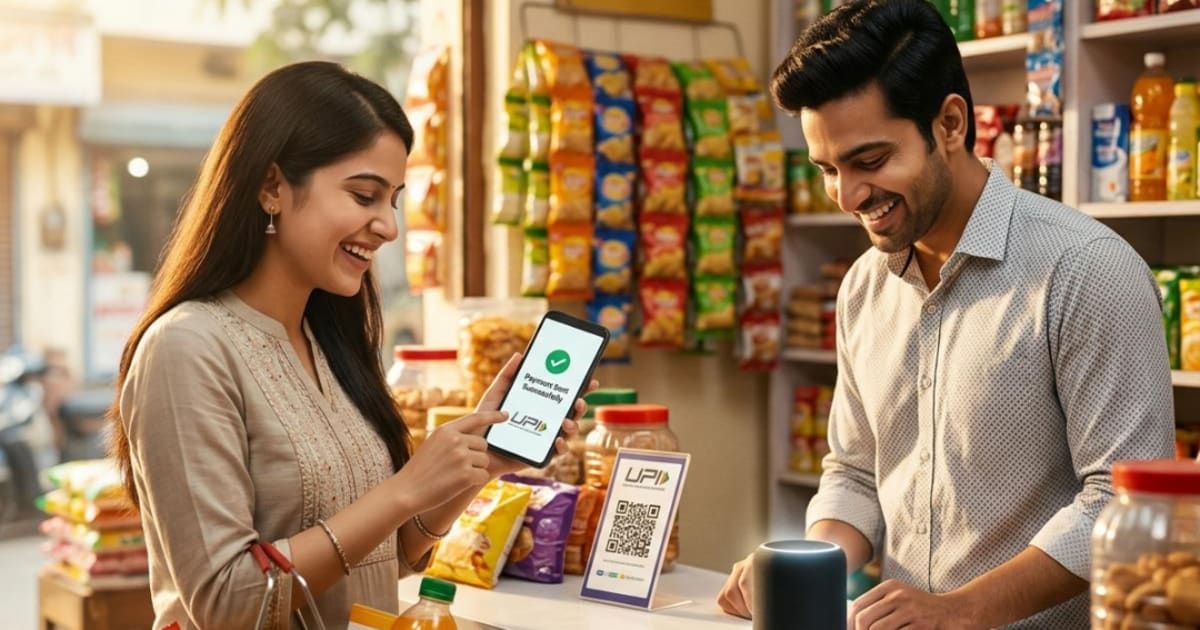
PhonePe processes roughly 47-48% of India's UPI transactions by volume — a dominant position built over nearly a decade of product quality, reliability, and consumer trust. The platform has over 650 million registered users, a figure that dwarfs every other fintech in India. The user base is not in question. The revenue model is.
With zero MDR on UPI, PhonePe earns almost nothing directly from the transaction that 650 million users perform on its platform. Revenue instead comes from four secondary streams: insurance premium commissions (acting as a corporate agent for multiple insurers), mutual fund distribution commissions under the PhonePe Wealth brand, lending partnerships where PhonePe originates borrowers for bank partners and takes a referral fee, and brokerage and mutual fund transactions through its Share.Market platform.
PhonePe reported revenue of ₹7,630 crore for FY25, up 22% year-on-year. For the first half of FY26, revenue reached ₹3,918 crore — strong growth but with losses that widened to ₹1,444 crore from ₹1,203 crore in the same period the prior year. The losses widened because ESOP costs — employee stock option expenses — consumed 64% of H1 FY26 revenue, a proportion that underwriters found distinctly uncomfortable and that has no close parallel among listed Indian fintech peers: Paytm's ESOP costs run at approximately 2.3% of revenue, Pine Labs at around 7.5%.
EBITDA turned negative at approximately $158 million for the six months through September 2024, according to a Bernstein analysis — a trajectory that makes the company's path to profitability considerably less visible than what Paytm has demonstrated over its three years as a listed entity.
THE PAYTM COMPARISON: WHERE PHONEPE STANDS
The Ken's original piece asked whether PhonePe was worth more than Paytm's $7.9 billion valuation. That question now requires recalibration, because Paytm's own valuation has moved materially since then.
Paytm posted its first full profitable year in FY26, reporting a net profit of ₹552 crore against a loss of ₹663 crore in FY25 — a genuine, hard-won turnaround that took three years of cost restructuring and business focus. Revenue grew 22% to ₹8,437 crore. The company's current market capitalisation is approximately ₹62,000-65,000 crore — roughly $7.5 billion at current exchange rates. Its price-to-sales multiple on trailing revenue sits at approximately 8x.
PhonePe's IPO targeted a valuation of $9-10.5 billion. Its trailing FY25 revenue was ₹7,630 crore. That implies a price-to-sales multiple of approximately 9-10x at the IPO price — a premium to Paytm's current trading multiple, for a company that is currently losing more money than Paytm was losing at a comparable stage of its lifecycle.
The premium is justified only if one believes PhonePe's financial services revenue trajectory is materially better than Paytm's — which is an arguable but not obvious claim. PhonePe's distribution advantage is larger. Its user base is bigger. Its brand trust in payments is arguably stronger. But Paytm has proven, through actual financial results, that the model can reach profitability. PhonePe has not yet done so, and its ESOP cost structure makes the timeline to profitability harder to model with confidence.
THE NPCI CAP RISK: THE REGULATORY SWORD OF DAMOCLES
No honest assessment of PhonePe's valuation can skip the NPCI market share cap — and yet it remains the most consistently underpriced risk in every bull case discussion.
The National Payments Corporation of India proposed a 30% market share cap on any single UPI player in 2020, then deferred enforcement multiple times. The cap was most recently deferred to December 2026 — and has never been formally withdrawn. PhonePe currently holds approximately 47-48% market share. If enforced as written, PhonePe would need to shed roughly a third of its transaction volume, which would compress financial services revenue proportionally since the cross-sell opportunity depends on transaction engagement.
Amazon and Meta have reportedly been actively lobbying NPCI to enforce the cap — not from altruistic concerns about competitive balance, but because their own UPI products (Amazon Pay and WhatsApp Pay) would benefit from any forced contraction of PhonePe's share. The fact that commercially motivated parties are pushing for enforcement adds a dimension to this risk that was absent when the cap was first proposed.
The probability of full enforcement remains unclear. The government's own interest in maintaining payment stability and the practical difficulties of forcing a dominant player to shrink market share create countervailing pressures against strict enforcement. But a cap formally sitting on the regulatory calendar for December 2026 — months after the IPO would ideally complete — is a risk that public market investors will price into their bid, whether the company's prospectus acknowledges it prominently or not.

WHAT HAS ACTUALLY IMPROVED SINCE THE ORIGINAL VALUATION DEBATE
The original $12 billion valuation debate focused almost entirely on whether PhonePe could build financial services revenue fast enough to justify a payments-scale distribution platform. Eighteen months later, the evidence on that question is mixed but directionally encouraging.
Insurance has been the clearest success story. PhonePe is now one of India's largest corporate agents for term life insurance, with multi-crore policy issuances and genuine penetration into the sub-premium segment that traditional insurance distributors have historically underserved. The cross-sell of insurance to UPI users who were previously uninsured is a real, measurable business that generates recurring commission income.
Mutual fund distribution through PhonePe Wealth has grown, supported by SIP culture increasingly taking root in Tier 2 and Tier 3 India — exactly the customer segment where PhonePe's penetration is deepest. Share.Market, the stockbroking platform, now competes with Groww and Zerodha for first-time equity investors.
What has not accelerated as fast as the original bull case assumed is credit. PhonePe's lending business — acting as a loan service provider connecting borrowers to bank and NBFC partners — has grown, but the credit cycle tightening in unsecured personal loans during 2024-25 meant the growth was slower and more cautious than originally envisaged. The RBI's measures to reduce credit card usage for rent payments and other indirect credit channels also created headwinds specifically for PhonePe's financial services revenue.

THE $9-10 BILLION QUESTION
PhonePe's IPO, when it eventually comes, will ask public market investors to make a judgement that private markets have been unable to cleanly resolve: is the combination of UPI market leadership, 650 million users, and nascent financial services worth a premium to Paytm's proven-profitable, smaller-scale operations?
The answer depends on three things: whether ESOP costs normalise as a percentage of revenue as the company scales (they mathematically should, but the absolute expense is large); whether the NPCI cap remains deferred or is actually enforced; and whether financial services revenue can compound fast enough over the next 2-3 years to make the FY26 losses look like a temporary investment phase rather than a structural earnings problem.
For investors evaluating this deal, one comparison stands above all others in instructive value. Paytm's IPO in November 2021 was the most anticipated Indian fintech listing of its generation. It priced at ₹2,150 per share, opened at a loss, and traded down to ₹440 within twelve months — a 79% decline that destroyed enormous shareholder value and became a cautionary tale about paying premium multiples for unproven monetisation models at scale. That story ended, eventually, with Paytm turning profitable and rebuilding investor trust. But the journey cost three years and enormous shareholder value.
PhonePe's promoters are asking for a lower entry multiple than Paytm commanded in 2021. The business is, by most measures, more mature than Paytm was then. The market is more sober. The ESOP overhang is a known and manageable issue.
Whether the $9-10 billion valuation represents fair value for a business that dominates India's payments infrastructure but hasn't yet clearly demonstrated a profitable financial services model at scale — that, ultimately, is the question that every investor in this IPO will need to answer for themselves before bidding.

Nikunjj Jhawar is a Chartered Accountant (CA) and Chartered Financial Analyst (CFA) with nearly two decades of experience in the financial services industry. Having worked with global institutions such as HSBC and Credit Suisse in investment-related roles, he brings deep expertise in finance and markets. He is the Founder of mangopeoplenews.com, where he focuses on making complex topics in finance, markets and business accessible and relevant to everyday readers.