From Coal to Clean to Nuclear: Tata Power's ₹1 Lakh Crore Revenue Bet Is India's Most Ambitious Energy Transformation Story

In FY24, Tata Power's revenue was ₹61,542 crore. By FY30, the company wants it to be ₹1,00,000 crore. That is a 1.6x increase in six years — not through acquisitions or financial engineering, but through the most comprehensive energy transition underway at any Indian utility company today.
FY26 confirmed the trajectory is real. Consolidated revenue reached ₹63,681 crore, growing steadily from the FY24 base. PAT came in at ₹5,118 crore. EBITDA grew 11% year-on-year to ₹16,090 crore. The board recommended a dividend of ₹2.50 per share. And installed capacity reached 16.7 GW — with 47% now from clean sources, up from a company that was still predominantly coal-powered as recently as 2019.
The destination is clear. The path is ambitious. And at Tata Power's AGM, CEO Praveer Sinha laid out exactly what it is going to take to get from here to there.
THE ₹1,00,000 CRORE FORMULA: THREE MULTIPLICATIONS
The ₹1 lakh crore revenue target by FY30 requires not one but three parallel multiplications happening simultaneously. Revenue 1.6x. EBITDA 2x — from ₹16,090 crore today to ₹30,000 crore. PAT 2x — from ₹5,118 crore to ₹10,000 crore. The fact that EBITDA and PAT are targeted to grow faster than revenue is the key insight: Tata Power's margin expansion plan is as important as its growth plan. As the renewable energy and T&D businesses — both higher-margin than legacy thermal — become a larger share of the mix, the profitability per rupee of revenue improves structurally.
The capital plan backing these targets is equally specific. Total capex of ₹1.46 lakh crore between FY25 and FY30. Of that, approximately 60% goes into renewables. The remainder covers transmission and distribution infrastructure, solar cell and module manufacturing, and new technology bets including storage and eventually nuclear.
Capacity is targeted to reach 32 GW by FY30 — doubling from the current 16.7 GW. Within that, renewable capacity is expected to touch 23 GW, up from the current clean energy base, meaning the 70% green energy target by 2030 requires adding more than 13 GW of renewable capacity in four years — an average of roughly 3.25 GW annually. In context, India as a whole added approximately 25 GW of renewables in its best-ever year. Tata Power targeting 3+ GW annually for four consecutive years is a serious commitment from a single company.
Transmission line reach is expected to increase from 4,633 circuit kilometres to 10,500 ckm — more than doubling the distribution infrastructure that currently contributes approximately 65% of revenue through the T&D business.
THE SOLAR MANUFACTURING PLAY: 4.3 GW AND READY TO SCALE
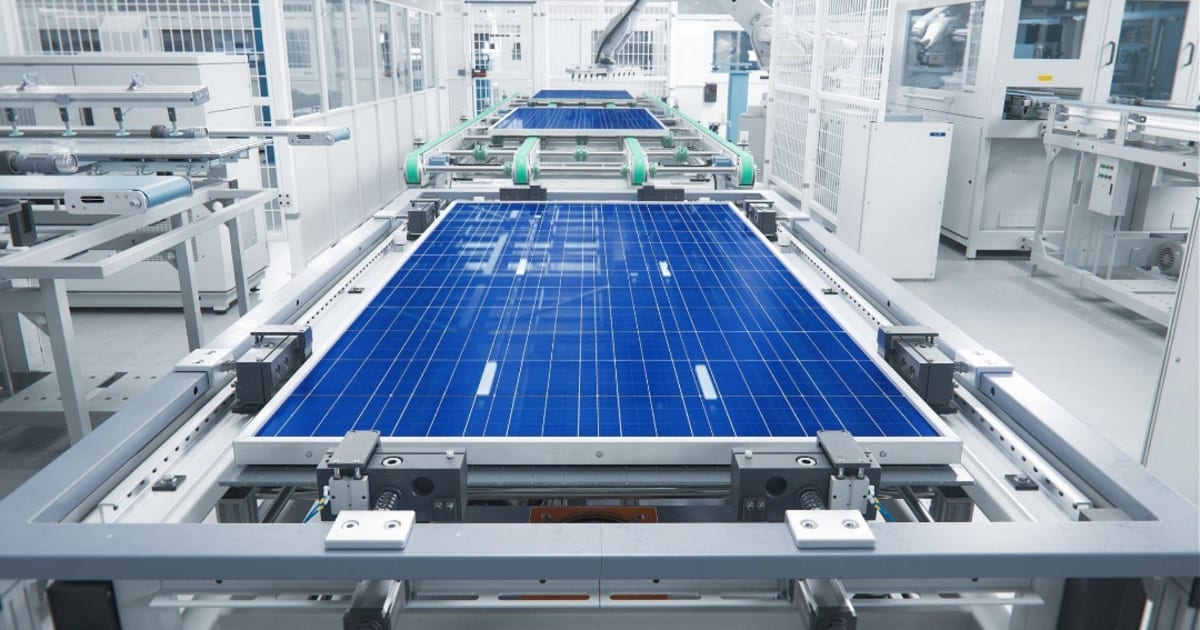
The most capital-intensive single investment in Tata Power's recent history is the 4.3 GW solar module and cell manufacturing facility at Gangaikondan near Tirunelveli, Tamil Nadu — built with an investment of ₹4,300 crore through its subsidiary TP Solar Ltd.
This plant is now operational and producing modules that are on the government's Approved List of Models and Manufacturers, making them eligible for deployment under PM Surya Ghar Yojana and other government solar programmes. Sinha confirmed at the facility's inauguration that all production for the next 12 to 16 months is already tied up with projects — meaning the plant was sold out before it even began producing.
The logic of backward integration into manufacturing is straightforward: Tata Power plans to build approximately 3 GW of solar capacity annually as part of its renewables expansion. Sourcing that solar capacity from its own module factory — rather than buying from Chinese or other suppliers — removes supply chain risk, captures the manufacturing margin internally, and aligns with the government's push for domestically manufactured solar equipment.
The facility also has optionality to add another 4 GW of capacity, which could be triggered if project demand continues at current pace. The modules from Tirunelveli are designated for the domestic market only, with Sinha stating clearly that Indian demand is large enough to absorb everything the plant can produce.
ROOFTOP SOLAR: INDIA'S MARKET LEADER FOR NINE CONSECUTIVE YEARS
The PM Surya Ghar Muft Bijli Yojana — the government's flagship rooftop solar subsidy scheme for residential consumers — has created a massive addressable market for rooftop solar installation companies. Tata Power is the dominant player in this space, holding 13% market share and maintaining market leadership for nine consecutive years.
Under the Ghar Ghar Solar campaign, Tata Power has installed more than 1 lakh rooftop solar systems totalling over 2.5 GW of capacity across residential, commercial, and industrial consumers. The company plans to add 30 lakh households in the next three years — a target that, if achieved, would require a massive scale-up of its 500+ channel partner network, which Tata Power plans to expand to 5,000+ over the same period.
The rooftop solar business generates recurring revenue not just from installation but from maintenance, monitoring, and eventually from battery storage add-ons as technology improves and costs fall. It also creates a direct consumer relationship — something rare for a utility — that can eventually support additional energy services.
THE NUCLEAR UPDATE: OPEN TO PPP, WAITING FOR GOVERNMENT
The most watched element of Sinha's recent statements was the update on nuclear energy — a category where Tata Power's interest has been telegraphed for months but where formal commitments require a government policy framework that doesn't yet exist.
Sinha's position is clear and consistent: Tata Power is open to exploring nuclear energy through public-private partnerships, but only once the government gives the formal go-ahead for private sector participation in nuclear power generation.
India's nuclear power sector has historically been entirely government-controlled, operated through the Nuclear Power Corporation of India Ltd (NPCIL) and governed by the Atomic Energy Act of 1962, which explicitly limits private participation. The government announced in the Union Budget 2025 its intention to open nuclear power to private sector participation and committed to developing 5 GW of nuclear capacity. The policy framework to implement this announcement — specifically the amendments to the Atomic Energy Act required for private entry — is still being developed.
Tata Power's nuclear interest is strategic rather than immediate. Nuclear power provides firm, dispatchable baseload generation that wind and solar cannot — electricity that can be generated on demand, regardless of weather conditions, 24 hours a day. As India's renewable share grows toward 70% of Tata Power's own portfolio, the need for firm power to balance intermittent renewables becomes more acute. Nuclear power fits that requirement precisely.
The company's readiness to participate in nuclear once the policy framework is in place — combined with its strong government relationships and its track record on large complex infrastructure — positions it as a natural first mover when private nuclear becomes formally enabled.

THE EV CHARGING BUSINESS: A QUIET BUT GROWING REVENUE STREAM
One dimension of Tata Power's FY30 strategy that receives less attention than renewables and nuclear is the electric vehicle charging infrastructure business.
Tata Power currently operates one of India's largest public EV charging networks — with stations across highways, malls, offices, and housing societies — and has been the primary charging partner for Tata Motors' EV customers through a tied relationship within the Tata ecosystem.
As EV adoption accelerates — Tata Motors itself targeting 20% EV market share by 2030 — the captive charging demand from Tata vehicle owners alone provides a base load for the charging infrastructure. Beyond that captive customer base, Tata Power's charging network serves vehicles from every OEM, creating a standalone infrastructure business with recurring usage revenue.
The scaling of this business requires capital — charging stations, grid connections, operational monitoring — but the asset base, once built, generates recurring revenue with minimal ongoing cost. It is exactly the kind of high-capex-upfront, recurring-revenue-downstream business model that Tata Power's utility DNA is well suited to operate.
WHAT THE FY26 NUMBERS TELL US ABOUT THE FY30 GAP
The journey from ₹63,681 crore in FY26 revenue to ₹1,00,000 crore by FY30 requires roughly 12% compounded annual revenue growth over four years. The EBITDA target — 2.4x from the current ₹16,090 crore to ₹30,000 crore — requires 17% EBITDA CAGR. The PAT target — 2.5x from ₹5,118 crore to ₹10,000 crore — requires approximately 18% PAT CAGR.
These are not implausible targets for a company deploying ₹25,000 crore of capex annually, in markets where India's power demand is growing at 6-8% annually and renewable capacity is structurally undersupplied. But they require execution precision across renewable project commissioning, T&D expansion, solar manufacturing utilisation, and rooftop solar rollout — all simultaneously.
The CRISIL AA+ rating secured in 2024, the steady FY26 performance, and the 11% EBITDA growth in a year when several infrastructure companies faced margin pressure all suggest the operational machine is functioning at a level that makes the FY30 targets credible rather than aspirational.
THE STOCK AND THE VALUATION
Tata Power shares are currently trading at approximately ₹375-385, giving the company a market capitalisation of approximately ₹1.2 lakh crore. The stock has delivered modest returns over the past year, with the market focused more on near-term earnings delivery than on the FY30 targets.
At current prices, the stock trades at approximately 24x FY26 PAT — a premium that implies the market is giving Tata Power credit for the renewable transition and the growth trajectory ahead, but is not yet assigning full FY30 target multiples to a business whose most transformative projects are still in the capex rather than the revenue phase.
The re-rating catalyst, when it comes, will likely be one of two things: the first quarter in which EBITDA margin meaningfully exceeds 25% as renewable capacity displaces expensive thermal generation in the mix, or the formal announcement of a nuclear PPP that gives investors a new, long-duration growth vertical to price.

Nikunjj Jhawar is a Chartered Accountant (CA) and Chartered Financial Analyst (CFA) with nearly two decades of experience in the financial services industry. Having worked with global institutions such as HSBC and Credit Suisse in investment-related roles, he brings deep expertise in finance and markets. He is the Founder of mangopeoplenews.com, where he focuses on making complex topics in finance, markets and business accessible and relevant to everyday readers.