Volkswagen India- JSW Talks: What a Potential Stake Sale Says About the Carmaker’s Struggles
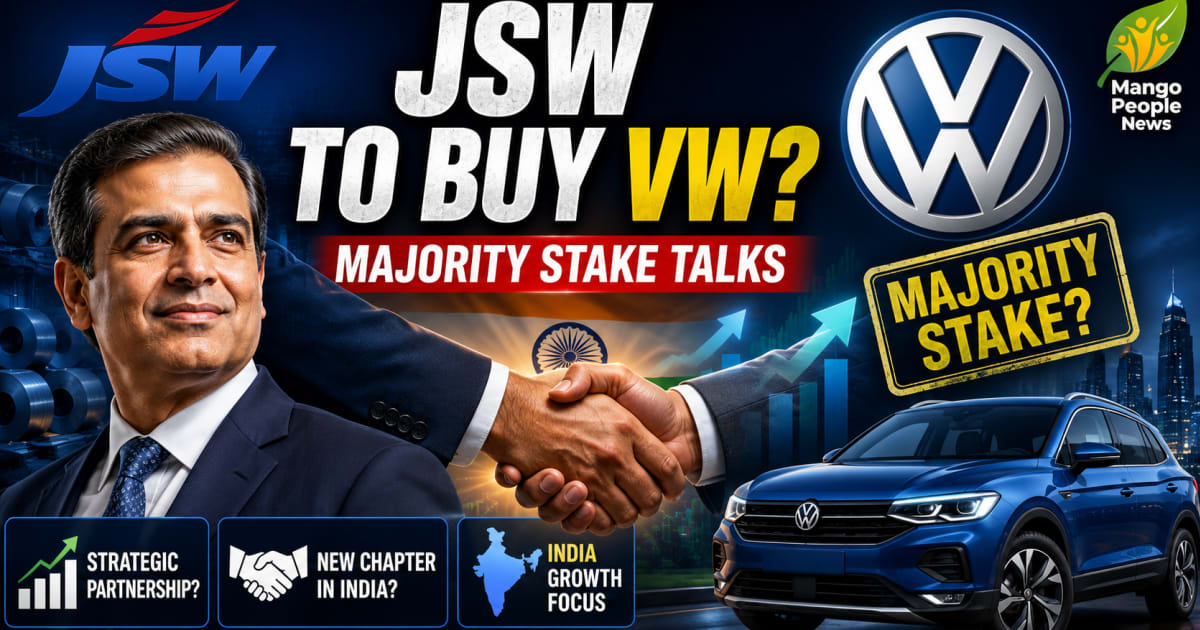
Volkswagen’s reported talks to sell a stake in its India business to JSW Group point less to expansion than to pressure. The discussion suggests a global carmaker trying to repair a weak local position in one of the world’s most difficult passenger-vehicle markets.
JSW is reportedly seeking a majority stake in Skoda Auto Volkswagen India, but several issues remain unresolved, including valuation and how much capital each side would commit. That alone signals that the deal is still far from settled and that the negotiations are being driven by necessity as much as opportunity.
Why Volkswagen is under strain in India
Volkswagen has spent years trying to build scale in India, but the business has not turned into a dominant local franchise. The company has engineering strength and established brands, yet its market position remains modest relative to the size and competitiveness of the Indian auto sector.
The latest financial numbers show a business that has improved in some quarters but still lacks the scale and margin profile needed for long-term comfort. Skoda Auto Volkswagen India reported FY25 revenue of about Rs 19,053 crore, while net profit for the year remained almost flat at Rs 94 crore, underscoring the gap between revenue size and earnings power.
What JSW is really getting
For JSW, the attraction is not just entry into automobiles. It is access to an existing operating platform, global product knowledge and a recognised brand that already has a presence in India.
But the deal would also expose JSW to a business that has not yet proved it can scale into a durable volume leader. A majority stake may offer influence, but it also means taking on a unit that still needs capital, strategic clarity and a stronger India-specific growth plan.
The unresolved points matter
The fact that talks remain focused on valuation and capital contribution is significant. In large industrial deals, those are usually the hardest issues to settle because they determine who absorbs the risk and who controls the future direction of the business.
If Volkswagen wants a financial and strategic partner, it may also have to accept less control. If JSW wants control, it will have to justify paying for a business that still needs sustained investment before it can deliver meaningful returns.
What the deal says about Volkswagen’s India strategy
The negotiations suggest Volkswagen is reassessing how much it can do alone in India. Rather than relying only on internal capital and imported strategy, the company appears to be considering a local partner as a way to stay relevant in a market where scale is brutally important.
That is a notable shift. It implies Volkswagen may no longer view India as a market where brand strength alone can compensate for weak market share, high localisation costs and intense competition.
JSW’s larger ambition
JSW’s interest also fits its broader industrial strategy. The conglomerate has already shown strong ambition in mobility and electric vehicles, and a stake in Volkswagen’s India business would be another step toward a larger automotive footprint.
Yet the move is not without risk. JSW is already planning its own automotive push through JSW Motors, which adds another layer of complexity to its broader vehicle strategy. Taking a stake in Volkswagen’s India unit could create overlap, strategic dilution or capital strain if not managed carefully.
Market context remains difficult
India’s auto market rewards patience, localisation and volume. It does not usually reward global brands that arrive with strong reputations but weak adaptation. That is the core challenge Volkswagen has faced for years.
A JSW partnership may help on the capital and governance side, but it does not automatically solve the harder problems of scale, pricing and distribution. Those issues will still define whether the business becomes more competitive or merely better funded.
A cautious reading of the talks
For now, the most important thing is not whether a deal is announced, but what kind of deal emerges. A minority investment would suggest caution. A majority stake would suggest Volkswagen is ready to concede that its India business needs a deeper reset.
Either way, the negotiations are a sign of pressure, not confidence. They show a global automaker looking for a way to stabilise a business that has not yet found the formula for large-scale success in India.

Nikunjj Jhawar is a Chartered Accountant (CA) and Chartered Financial Analyst (CFA) with nearly two decades of experience in the financial services industry. Having worked with global institutions such as HSBC and Credit Suisse in investment-related roles, he brings deep expertise in finance and markets. He is the Founder of mangopeoplenews.com, where he focuses on making complex topics in finance, markets and business accessible and relevant to everyday readers.