

Ather Energy: 270% Stock Rally, ₹3,823 Crore Revenue, a Mass Market Scooter Coming in August — and the Race to 50,000 Units a Month That Decides Everything
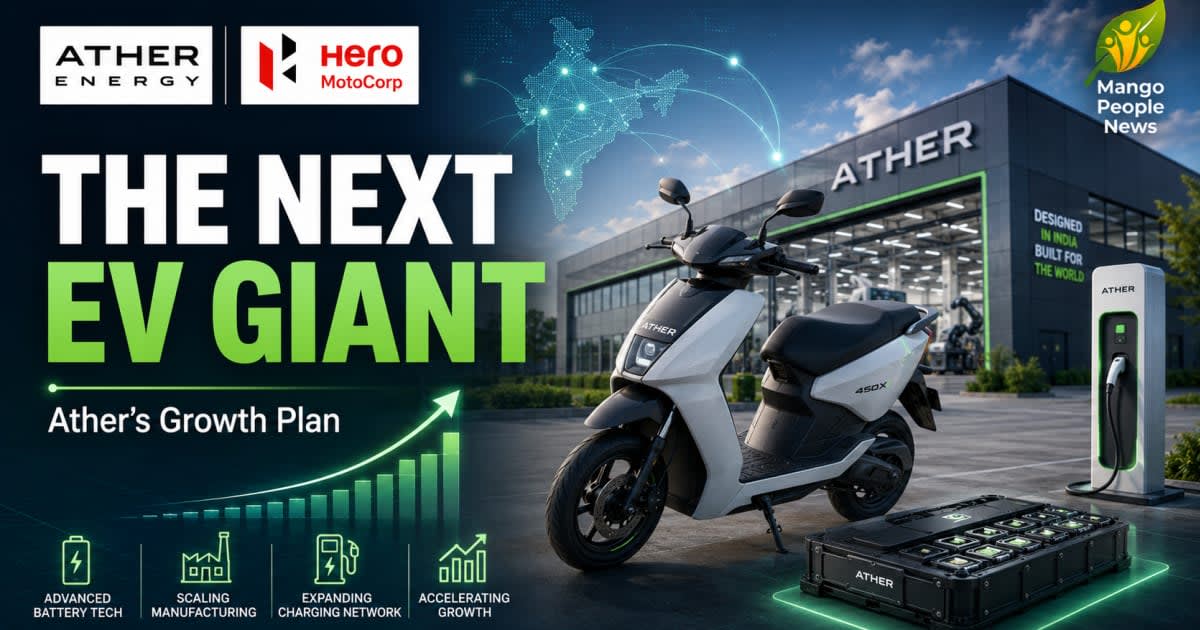
From Niche Premium to National Contender
Twelve years ago, two IIT Madras graduates — Tarun Mehta and Swapnil Jain — sat in a Bengaluru garage and asked a question that most Indian automotive executives hadn't taken seriously yet: what if a scooter was as smart as a smartphone?
Today, Ather Energy has delivered its strongest-ever performance in FY26, driven by growth in volumes, market share, and revenue, alongside a sharp reduction in EBITDA losses. The company sold 2,62,942 units — up 69% year-on-year. Revenue crossed ₹3,823 crore. Its stock has rallied 270% in the past year. And in August 2026, it will unveil its most important product yet: a mass-market electric scooter designed to take it beyond the premium segment that built its reputation.
None of this makes Ather profitable yet. But it does make Ather one of the most watched and most debated companies in Indian equity markets right now — a business that is simultaneously India's most technically sophisticated EV manufacturer and its most capital-intensive unlocking story.
FY26 Financial Performance — Record Numbers, Persistent Losses
The headline numbers from FY26 are genuinely impressive. Ather Energy concluded FY26 with Rs 3,823 crore in total income, marking a 66% year-on-year increase, alongside improved margins and narrowed net losses.
The company sold 2,62,942 units in FY26, up 69% YoY, and closed the year with record quarterly volumes of 83,418 units in Q4, up 76% YoY. EBITDA margins improved by ~1,630 bps YoY for the year and ~2,080 bps YoY in Q4, reflecting improving unit economics and operating leverage.
The unit economics story is where the real progress lies. Adjusted Gross Margin for FY26 reached ₹925 crore, up 116% YoY, with margin improving to 24% of total income, up ~500 bps YoY, driven by stronger product mix, value engineering, and rising contribution from software-led revenues.
EBITDA margin narrowed to (2.5%) in Q4 FY26, a ~2,080 bps improvement YoY, with EBITDA loss of ₹30 crore. That number — a negative 2.5% EBITDA margin in the best quarter — is the clearest signal that Ather is within striking distance of EBITDA breakeven at scale. The company has estimated that breakeven requires approximately 50,000 units per month. Q4 FY26 delivered 83,418 units in the quarter — roughly 27,800 per month. The gap is real, but it is closing.
The full-year bottom line remains challenging. Despite the impressive revenue growth, Ather Energy continues to grapple with persistent losses and substantial operational costs. The company has reported a net loss of Rs 517 crore for FY26.
Non-vehicle revenue, comprising software subscriptions, charging, accessories, spares, and service, rose to 13% of total income in FY26, reflecting deeper ecosystem penetration. This is the metric that makes Ather structurally different from a conventional vehicle manufacturer: 13% of revenue comes from software and services — a business with structurally better margins than hardware — and in Q4, 93% of customers opted for AtherStack Pro, underscoring strong engagement with Ather's software-led ecosystem.
The August Mass Market Scooter — Ather's Biggest Bet
The single most consequential product in Ather Energy's 12-year history will be unveiled in August 2026. The company is preparing to launch a mass-market electric scooter under the EL platform — designed to compete at a price point of ₹1–1.25 lakh, significantly below the ₹1.4–1.6 lakh range of its current Rizta and 450-series products.
This matters enormously for the market share and profitability story simultaneously. Ather's premium pricing strategy, with scooters ranging between ₹1.4 lakh and ₹1.6 lakh, places it approximately 25% higher than competitors like Ola Electric. This premium is becoming harder to sustain as government subsidies such as FAME II are reduced.
The EL platform changes that equation. By entering the ₹1–1.25 lakh segment, Ather would be competing directly with Ola Electric's mass-market models, Bajaj's Chetak range, and TVS iQube — the three competitors that dominate the volume segment of India's EV two-wheeler market. The addressable market at that price point is five to ten times larger than the premium segment Ather has historically served.
The risk is margin dilution. A lower-priced product typically carries a lower gross margin per unit. Ather's ability to maintain its 24% adjusted gross margin at the EL platform's price point — through manufacturing efficiency at its forthcoming Factory 3.0 — will be the key variable investors watch closely when the product launches.
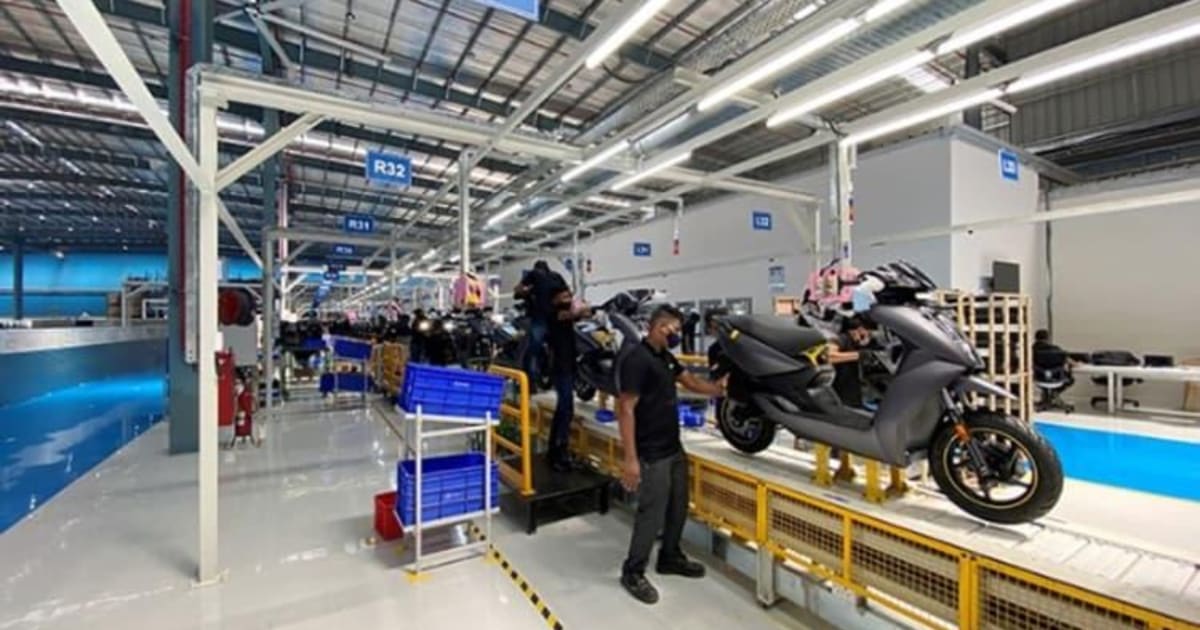
In June 2024, Ather Energy announced its move to set up a third manufacturing plant in Maharashtra with a capacity of 1 million units per annum. Factory 3.0, when operational, would give Ather the manufacturing scale to serve mass-market volumes without the cost-per-unit pressures that constrained its earlier expansion. While Ather's factory capacity is over 400,000 units annually, it utilized only 39% of this capacity in FY26. Factory 3.0 is the investment in capacity utilisation that the EL platform launch requires.
Hero MotoCorp's ₹1,000 Crore Fresh Investment — A Vote of Confidence
One of the most significant recent developments for Ather came from its longest-standing strategic investor. Hero MotoCorp — India's largest two-wheeler manufacturer and Ather's most important backer since its Series B in 2016 — has announced a fresh investment of approximately ₹1,000 crore in the company.
This investment is not routine financial support. It is a strategic reaffirmation from the company that arguably knows Ather's business most intimately, having backed it through multiple funding rounds across a decade. Hero's own EV journey — its Vida brand — has been growing, but the company has continued to increase its Ather stake consistently, signalling that it views Ather's technology and brand positioning as complementary to rather than competitive with its own EV ambitions.
The fresh Hero investment also carries a specific strategic dimension: Hero MotoCorp and Ather Energy have collaborated to create an interoperable fast-charging network for two-wheelers in India. Ather's charging ecosystem also scaled significantly during the year, with customers now having access to over 6,000 charging points powered by LECCS, making it the largest fast charging network for two-wheelers in India. Hero's own Vida customers can access the Ather Grid — meaning Hero benefits directly from Ather's charging infrastructure investment without having to build it independently. The capital going into Ather is, in part, capital going into the shared infrastructure that Hero also depends on.
The ₹2,500 Crore QIP — Funding the Next Phase
Beyond Hero MotoCorp's investment, Ather's board approved a larger capital raise in July 2026. Ather Energy plans to raise ₹2,500 Cr via QIP after a strong FY26, with EBITDA losses narrowing to 2.5%. Funds will support R&D, marketing, debt repayment, and infrastructure as Ather faces competition from Ola, TVS, and Bajaj.
Capital raised from the placement will fund expansion plans as competition intensifies in India's electric vehicle market. The company will use the funds to broaden its production capabilities, grow its retail footprint and develop new offerings, including expanding its vehicle range and charging network. HSBC, Axis Capital, and Nomura have been appointed to manage the QIP process — a banker lineup that signals institutional confidence in the process.
The fund deployment plan for the $200 million equivalent raise covers four primary areas: Factory 3.0 construction and equipment procurement, retail network expansion beyond the current 700 experience centres, R&D for the EL platform mass-market scooter and future products including potentially an electric motorcycle, and Ather Grid charging network densification.
Each of these is a genuine investment in future revenue rather than a funding of current losses. Factory 3.0 enables the EL platform to be manufactured at scale. Retail expansion captures the geographic coverage that the EL platform will require to compete on volume. R&D ensures the product pipeline stays ahead of competitors. And Ather Grid densification maintains the charging infrastructure advantage that distinguishes Ather from every competitor in its category.
Market Share Journey — From 12.1% to a Record High
Ather's market share trajectory in FY26 is one of the most impressive competitive comebacks in India's automotive sector in recent memory.
Ather Energy achieved a 17.4% national market share in Q2 FY26, up from 12.1% in the same quarter last year. The company maintained its leadership in South India, where market share climbed to 25%, underscoring Ather's strong brand loyalty and dealer network. Meanwhile, Middle India — comprising Gujarat, Maharashtra, Madhya Pradesh, Chhattisgarh, and Odisha — emerged as the fastest-growing region with a 14.6% share, up sharply from 8.8% last year. South India remained the strongest region, retaining leadership with a 23.5% market share in Q4 FY26. Middle India saw the fastest growth, with the share rising to 17.3% in Q4 FY26 from 9.5% a year ago, while Rest of India grew to 12.1% in Q4 FY26 from 6.5% in Q4 FY25.
The geographic diversification of this market share expansion is the most strategically significant dimension. Ather began as a Bengaluru-first, South India-centric brand. Its ability to build 17.3% market share in Middle India — states that were historically low-awareness markets for a premium brand — demonstrates that the Rizta family scooter has done exactly what it was designed to do: unlock a much larger addressable market than the performance-focused 450 series could reach.
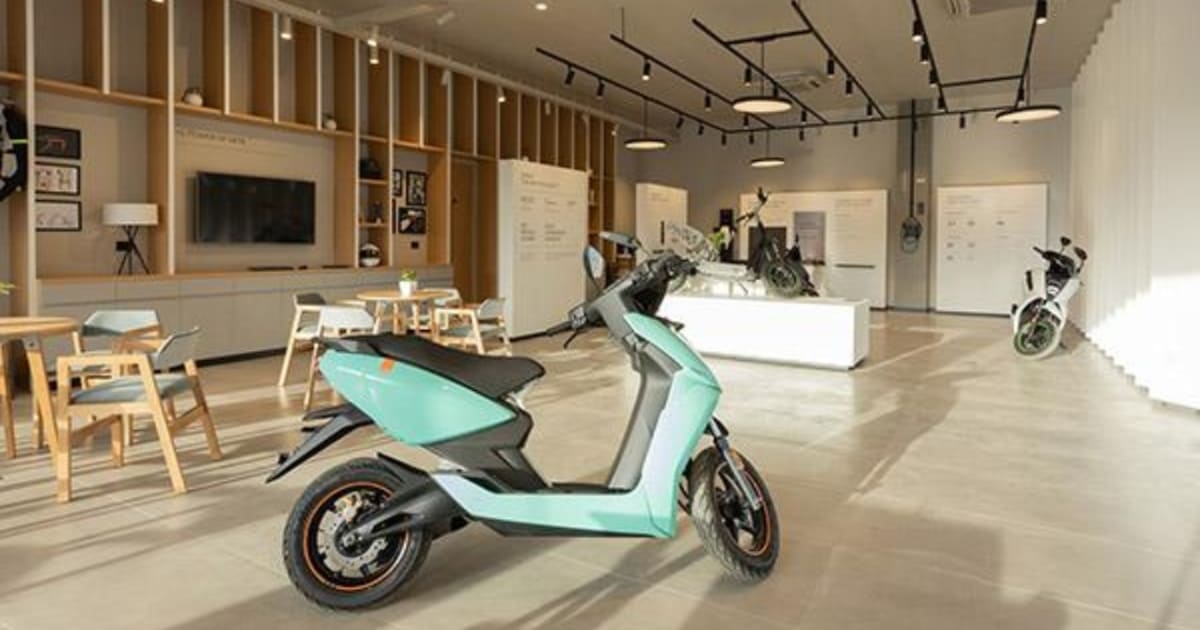
Ather Energy continued its nationwide expansion during Q2, adding 78 new experience centres to take its total count to 524 ECs across India. In the first half of FY26 alone, the company added 173 new ECs, a testament to its aggressive yet balanced retail strategy targeting both metropolitan hubs and tier-2 and tier-3 cities. The company doubled its retail network during the year, ending FY26 with 700 Experience Centres, up from 351 at the end of FY25.
June 2026 — The Latest Monthly Momentum
The most recent monthly sales data confirms that momentum into FY27 is strong. Ather Energy June sales rise 114.5% YoY to 31,188 units, beating estimate. Sales surpassed forecast of 31,100 units, highlighting strong performance. (Kotak Neo)
31,188 units in June represents the kind of monthly run rate that is approaching — though not yet at — the 50,000 units per month threshold management has identified as the EBITDA breakeven point. The 114.5% YoY growth rate also confirms that Ather's performance in FY26 was not a one-year anomaly but an ongoing structural acceleration.
If the August mass-market scooter launch is well-received and drives incremental volume in the ₹1–1.25 lakh segment, monthly registrations could approach the 40,000–50,000 range by Q3 FY27 — which is when the profitability story could become meaningfully more visible in the quarterly numbers.
The Competitive Landscape — A Three-Front War
TVS Motor led the segment in FY26, selling 341,513 units for a 24.36% market share, followed by Bajaj Auto with 289,349 units. Its key competitors in the electric scooter market include Ola Electric Mobility, TVS Motor and Bajaj Auto.
The competitive dynamics in India's EV two-wheeler market have shifted meaningfully over the past 18 months. Ola Electric — which once held over 40% market share — has been recovering from a severe service quality crisis that saw its monthly sales fall as low as 3,973 units before recovering to approximately 15,000 per month. TVS has used that period to build a genuinely formidable position across multiple price points with the iQube range. Bajaj's Chetak has built strong brand equity in the value segment. And Ather has been the primary market share gainer among well-capitalised players during the period of competitive realignment.
The August launch of the EL platform mass-market scooter will be Ather's most direct challenge to this competitive order. If it successfully takes on Ola, Bajaj, and TVS in the ₹1–1.25 lakh segment — while maintaining the software and ecosystem differentiation that commands customer loyalty in its existing products — it would represent a genuine transformation of the company's competitive position from premium niche to mainstream contender.
The Ecosystem That Makes Ather Different
The dimension of Ather's business that most distinguishes it from every other EV manufacturer in India is the software and ecosystem layer that sits on top of the physical product.
In Q4, 93% of customers opted for AtherStack Pro, underscoring strong engagement with Ather's software-led ecosystem. AtherStack Pro is a subscription service that gives customers access to navigation, over-the-air updates, trip analytics, and remote vehicle monitoring. The 93% uptake rate means almost every Ather customer is paying for a recurring software subscription — creating an annuity revenue stream that no conventional scooter manufacturer can replicate.
Non-vehicle revenue, primarily from Ather's ecosystem offerings such as software subscriptions, charging, accessories, spares, and service, contributed 12% of total income.
As the customer base scales — from 262,942 units in FY26 toward potentially 400,000–500,000 units in FY27 if the EL platform performs — the software subscription revenue compounds proportionally with units sold, while the marginal cost of serving each additional subscriber through the existing platform is minimal. That is the margin accretion engine that should eventually lift Ather's blended margins well above what a hardware-only EV company would achieve.
Ather's charging ecosystem scaled significantly during the year, with customers now having access to over 6,000 charging points powered by LECCS, making it the largest fast charging network for two-wheelers in India. The charging infrastructure creates a flywheel: Ather Grid's density makes Ather vehicles more appealing to consumers considering an EV purchase, which drives sales, which funds further charging network expansion, which further strengthens the product proposition.
What to Watch — The Milestones That Define the Next 12 Months
August EL Platform Launch.
The mass-market scooter announcement is the most critical product event in Ather's history. Watch the price point, the spec sheet, and the initial booking response. If the product is priced at ₹1–1.1 lakh with competitive range and a credible software ecosystem, it materially expands Ather's addressable market. If it is positioned at ₹1.2–1.25 lakh, the addressable expansion is more modest.
Monthly sales trajectory toward 50,000 units. The EBITDA breakeven threshold is approximately 50,000 units per month. June 2026 delivered 31,188. Q3 FY27 monthly volumes — with the EL platform added to the product portfolio — will determine how quickly that threshold is approached.
QIP completion and investor lineup.
The ₹2,500 crore QIP process has been formally initiated with HSBC, Axis Capital, and Nomura appointed. Watch for completion of the fundraise and the price at which it prices — institutional investors buying at QIP price provide the clearest external validation of Ather's equity value.
Factory 3.0 construction timeline.
The Maharashtra facility capable of 1 million units annually is the infrastructure investment that enables mass-market scale. Watch for groundbreaking milestones and the commissioning timeline that will determine when manufacturing costs begin benefiting from Factory 3.0's scale economies.
EBITDA margin trajectory.
Q4 FY26 delivered -2.5% EBITDA margin. The direction is clearly positive — 1,630 bps improvement for the full year is significant operational progress. Watch whether Q1 FY27 sustains or improves on that -2.5% level even as the EL platform launch generates associated costs.
Hero MotoCorp collaboration announcements.
Beyond the financial investment, Hero's interoperable fast-charging partnership and any deeper product or technology collaboration that emerges from the ₹1,000 crore investment relationship will signal how the two companies intend to divide the EV market between them.
The Honest Assessment
Ather Energy is one of those rare companies that divides investors precisely because it is genuinely difficult to value. It is not a startup anymore — ₹3,823 crore in revenue, 262,942 units sold, 700 experience centres, the largest two-wheeler fast-charging network in India, and a stock up 270% in a year are not startup metrics.
But it is not yet a profitable mature company either. The net loss of ₹517 crore in FY26 on ₹3,823 crore of revenue is not catastrophic — at 13.5% of revenue, it is a loss rate that many growth-stage technology companies would consider acceptable. But the EV industry, unlike software, requires continuous heavy capital investment in manufacturing, charging infrastructure, and R&D — which means the path from loss to profit is neither fast nor cheap.
To achieve breakeven, Ather needs to sell around 50,000 units monthly, a target it has not yet consistently met. The August EL platform launch, the QIP fundraise, Hero MotoCorp's fresh capital, Factory 3.0's construction, and the June sales momentum of 31,188 units are all inputs to whether that 50,000-unit monthly threshold can be reached in FY27.
If it can, Ather's EBITDA turns positive, the net loss begins to narrow meaningfully, and the 270% stock rally over the past year begins to look like the beginning of a re-rating rather than the end of one. If the EL platform disappoints, volumes plateau, and the quarterly losses remain at current levels, the valuation at 12x revenues will compress.
The next twelve months — product launches, quarterly sales, and the commissioning of Factory 3.0 — will provide the data needed to resolve that uncertainty. For an investor with conviction on India's EV adoption trajectory, the continued market share gains, the software ecosystem advantage, and the institutional backing from Hero MotoCorp make Ather the most technically credible way to own that conviction in the public markets today.

Nikunjj Jhawar is a Chartered Accountant (CA) and Chartered Financial Analyst (CFA) with nearly two decades of experience in the financial services industry. Having worked with global institutions such as HSBC and Credit Suisse in investment-related roles, he brings deep expertise in finance and markets. He is the Founder of mangopeoplenews.com, where he focuses on making complex topics in finance, markets and business accessible and relevant to everyday readers.
