NMDC Explained: Business, Financials & Coal Push
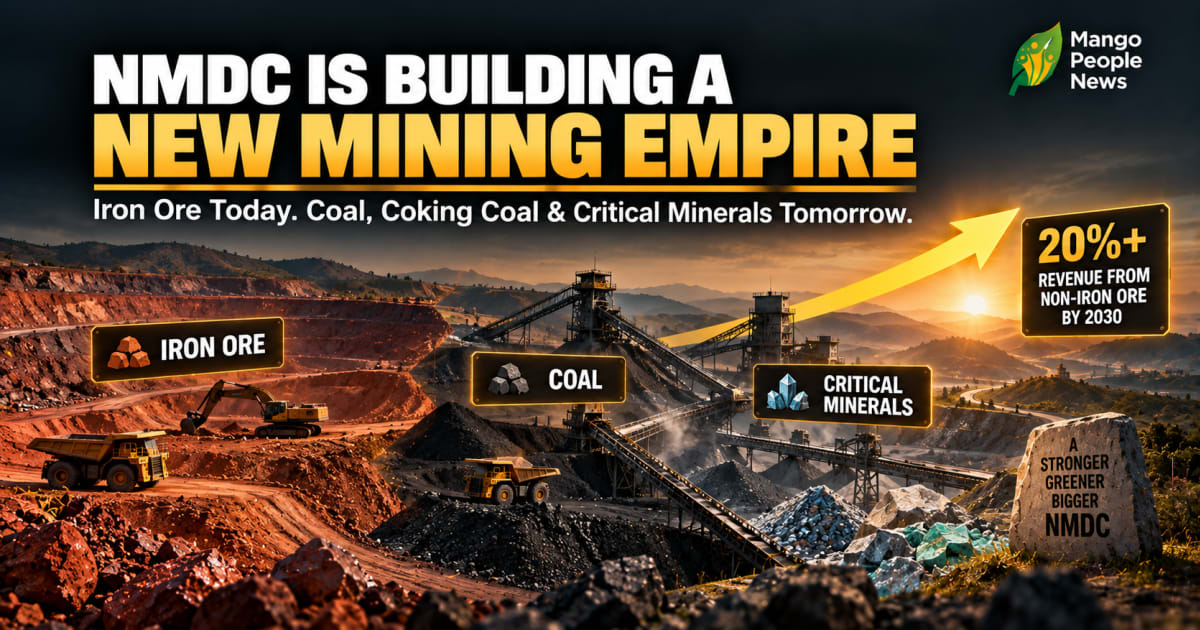
For nearly seven decades, NMDC has meant one thing to India: iron ore. The state-run miner supplies roughly a fifth of the country's entire iron ore needs — the raw material that goes into every tonne of Indian steel. But in the company's own words, that's about to change. "Right now, we are 99.9 per cent an iron ore company," NMDC Chairman Amitava Mukherjee said in an interview published just this week, laying out plans to turn NMDC into a full-fledged, diversified mining major over the next few years. Here's the full picture — from its origins to where it's headed next.
A Brief History: Built To Secure India's Iron Ore
NMDC — originally the National Mineral Development Corporation — was incorporated in November 1958, in the early years of India's post-independence industrial push, with a clear mandate: explore and develop the country's mineral wealth, particularly iron ore, to feed its growing steel industry. It started small, producing around 10 million tonnes (MT) of iron ore a year by 1978, largely from mechanised mines in Chhattisgarh's Bailadila range.
Growth was steady rather than spectacular for most of its history — reaching about 30 MT by 2015. But the pace has picked up sharply since then: annual production nearly doubled from 30 MT to a record 53 MT in FY26, with almost a fifth of that growth added in just the last four years. In FY26, NMDC became the first mining company in India to cross the 50 MT mark in a single year — a milestone the company has directly credited to what it calls "NMDC 2.0," a sharper, faster execution push under current management.
Along the way, NMDC earned Navratna status in 2008 (a designation given to top-performing government companies that grants them greater operational and financial autonomy) and listed on the stock exchanges the same year. The Government of India remains the majority owner, holding just over 60% of the company.
What NMDC Actually Does
At its core, NMDC mines and sells iron ore — mainly from fully mechanised operations in Chhattisgarh (its largest source, in the Bailadila hills) and Karnataka (the Kumaraswamy and Donimalai mines), where mining leases have recently been extended out to 2035. Beyond raw ore, the company also sells iron ore pellets (a processed, higher-value form of the ore used directly in steelmaking), runs India's only mechanised diamond mine at Panna in Madhya Pradesh, and generates a small amount of revenue from wind power.
Financials: Record Volumes, Steady Profit Growth
NMDC's numbers over the past year tell a story of a business firing on most cylinders. For the full year FY26, the company reported a 33% jump in total revenue to an all-time high of over ₹31,000 crore, driven by record iron ore volumes and firmer prices. The most recent quarter on record, Q4 FY26, saw standalone net profit jump 35% year-on-year to ₹2,020 crore on revenue of ₹11,173 crore.
The most recent quarterly filing, for Q1 FY27 (April-June 2026), showed steadier, more modest growth: standalone profit after tax rose 2% year-on-year to ₹2,007 crore, on revenue of ₹6,795 crore, up 2.4%. It's worth noting that the same filing flagged some real balance-sheet items investors should track — including sizeable contingent liabilities and over ₹11,000 crore in outstanding receivables owed to NMDC by NMDC Steel and Rashtriya Ispat Nigam Limited (RINL), two customers with their own financial pressures.
On production, NMDC's August 2026 monthly update showed iron ore output of 4.07 MT and sales of 3.58 MT, keeping the company on track for its FY27 target of 60 MT — a meaningful step up from the 53 MT delivered in FY26.
Valuation: What Investors Are Paying For NMDC Today
As of early September 2026, NMDC commanded a market capitalisation of roughly ₹74,000-74,500 crore, with shares trading around ₹84-85 — near the upper end of a 52-week range of roughly ₹72-97. At this price, the stock trades at a trailing price-to-earnings (P/E) ratio of just under 10 times, which looks inexpensive next to the broader market, though this reflects how commodity mining stocks are typically valued given the cyclical nature of metal prices. The stock has also been a strong recent dividend payer, having declared ₹2.50 per share for the December 2025 quarter alone — translating to a trailing dividend yield in the high single digits, a feature that has traditionally made NMDC popular with income-focused investors.
What Analysts Are Saying
Brokerage sentiment toward NMDC has generally stayed positive through 2026, anchored by the story of rising volumes and iron ore prices. Motilal Oswal's Siddhartha Khemka has flagged both NMDC and Coal India as "must-watch mining plays" as spot commodity prices have surged, while other market commentators have highlighted NMDC alongside names like Jindal Steel as beneficiaries of the broader metals cycle.
That said, formal analyst price targets on the stock have moved up only gradually through the year — automated consensus-tracking tools have shown targets creeping from around ₹73-75 toward the high-₹70s over the course of 2025 into 2026, even as the stock itself has already traded above those levels for stretches, at one point touching a 52-week high near ₹97. This gap is worth flagging honestly: it suggests formal published targets have, at times, lagged behind the stock's own momentum, rather than the stock trading at a clear, analyst-endorsed discount. As always with single-commodity miners, the more reliable signal tends to be the trajectory of iron ore prices and volumes rather than any one price target.
The Big Shift: NMDC's Move Into Coal, Coking Coal And Beyond
The most significant story at NMDC right now isn't in iron ore at all — it's the company's deliberate push to stop being a single-commodity business.
Why NMDC Is Diversifying
Chairman Mukherjee has been explicit about the ambition: to make NMDC "India's largest mineral mining company," not just its largest iron ore producer, and to reduce the concentration risk of depending almost entirely on one commodity's price cycle. The stated target is for at least 20% of NMDC's revenue to come from minerals other than iron ore by 2030 — a significant shift from today's near-total reliance on ore.
Coal And Coking Coal: The First New Business Line
NMDC's most tangible diversification move so far is coal. The company won two coal blocks in Jharkhand's Hazaribagh district through a government auction: the Tokisud North block, with extractable reserves of about 52 MT of thermal coal and a planned capacity of 2.3 MT per year, and the Rohne block, a coking coal deposit (a higher-grade coal used specifically in steelmaking, which India currently imports in large volumes) with reserves of roughly 191 MT and a planned peak capacity of 8 MT annually.
Mining has already begun at Tokisud North, and the company expects to start commercial thermal coal production between October and December 2026, targeting sales of up to 1 MT within FY27 — a modest opening volume, but a historic first for a company that has never sold coal before. The coking coal block at Rohne is targeted to follow, subject to pending regulatory approvals. Management has estimated that, within three years, this coal business alone could generate annual revenue of ₹5,000-8,000 crore — a meaningful new income stream layered on top of the core iron ore business.
Beyond Coal: Critical Minerals And Overseas Ambitions
NMDC's diversification plans extend well past coal. The company has identified a list of 10 minerals for expansion and is actively pursuing copper, lithium, cobalt, nickel, gold and bauxite opportunities, both within India and overseas. It has set up a dedicated subsidiary focused on rare earths and critical minerals, and signed an agreement with Gujarat Mineral Development Corporation for a rare earth project. Internationally, NMDC opened an office in Dubai in July 2025 specifically to scout acquisitions and partnerships across Africa, the Middle East, Latin America and Southeast Asia, and has also explored a lithium-related tie-up in Australia through Legacy Iron Ore in partnership with Gina Rinehart's Hancock Prospecting.
In a sign of how fast this international push is moving, NMDC incorporated a new wholly-owned subsidiary, NMDC Global IFSC Limited, in Gujarat's GIFT City financial hub as recently as September 2, 2026 — a structure typically used by Indian companies to route and manage international deals and investments more efficiently.
Future Growth: The Road To 100 Million Tonnes
Iron ore still remains the core growth driver in the near term, and the numbers here are ambitious. NMDC is targeting 60 MT of iron ore production in FY27, climbing toward an eventual goal of 100-110 MT by the end of the decade — very nearly doubling today's already-record output. Getting there will require serious capital: management has guided toward total capital expenditure of ₹40,000-50,000 crore over the next three years, with annual capex expected to rise from around ₹6,000-7,000 crore in FY27 to a steady-state run-rate of ₹9,000-10,000 crore in the years after.
Put together, NMDC's growth story over the next few years rests on two parallel tracks: scaling up its existing iron ore business toward 100 MT through heavy, sustained capital investment, while simultaneously building an entirely new coal and critical-minerals business from scratch. Whether the company can execute on both fronts at once — without the newer, unproven businesses becoming a drag on the balance sheet before they mature — will likely determine whether NMDC's valuation catches up with its expanding ambitions.

Nikunjj Jhawar is a Chartered Accountant (CA) and Chartered Financial Analyst (CFA) with nearly two decades of experience in the financial services industry. Having worked with global institutions such as HSBC and Credit Suisse in investment-related roles, he brings deep expertise in finance and markets. He is the Founder of mangopeoplenews.com, where he focuses on making complex topics in finance, markets and business accessible and relevant to everyday readers.