

Swiggy Follows Eternal's Playbook - Caps Foreign Ownership: What It Means
A Second Attempt Succeeds Where The First One Failed
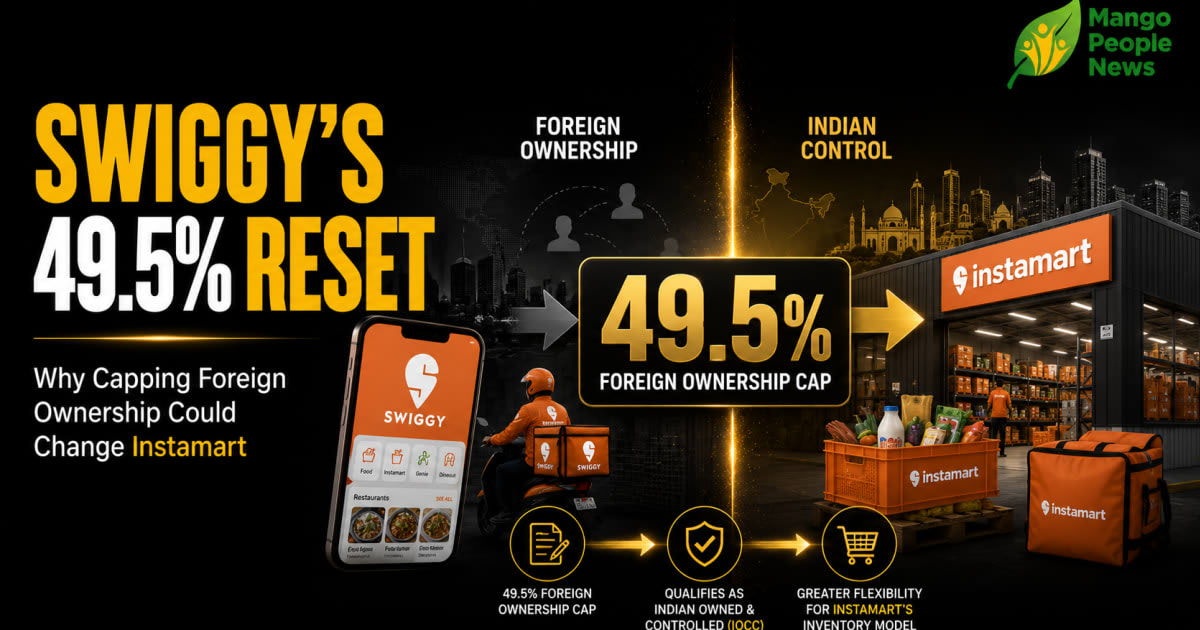
Swiggy has cleared a regulatory hurdle that eluded it just three months ago — and this time, shareholders left no room for doubt. At the company's 13th Annual General Meeting, more than 99.9% of shareholders voted in favour of capping Swiggy's aggregate foreign ownership at 49.5% and amending its Articles of Association to match.
The result is a sharp reversal from May 2026, when a nearly identical proposal secured only around 72% shareholder support — falling short of the 75% threshold a special resolution requires. That earlier defeat forced Swiggy to shelve the plan and, by the company's own admission, work more closely with its shareholder base to address whatever concerns had held the vote back the first time. Whatever those conversations involved, they clearly worked: this time, the same proposal cleared with almost unanimous backing.
Why A Foreign Ownership Cap Matters So Much To Swiggy
At first glance, capping how much foreign capital can sit in a company sounds like it works against Swiggy's interests, not for them. But under India's foreign investment rules, this cap unlocks something Swiggy has wanted for a while: recognition as an Indian-owned and controlled company, or IOCC, under the Foreign Exchange Management Act (FEMA).
That status matters because of a specific quirk in India's ecommerce regulations. Companies with majority foreign ownership are barred from directly stocking and selling their own inventory in ecommerce — they're restricted to operating as a marketplace, hosting third-party sellers instead. Swiggy's quick commerce arm, Instamart, has been operating under exactly that marketplace structure. IOCC status removes this restriction, clearing the way for Instamart to shift to an inventory-led model — buying products directly and selling them itself, rather than simply hosting other sellers on its platform.
The Blinkit Precedent Swiggy Is Following
Swiggy isn't charting new territory here. Rival Eternal (the parent company of Zomato and Blinkit) went through the exact same playbook roughly a year earlier, capping its own foreign ownership at 49.5% in April 2025 to unlock IOCC status for Blinkit.
The results of that shift offer a useful preview of what Swiggy might be hoping for. Blinkit's transition to an inventory-led model was expected to lift its take rate — the commission or margin a platform earns per transaction — from around 18% toward the low-20s percentage range, closer to what rival Zepto has historically commanded. The inventory-led structure also let Blinkit expand into categories that third-party sellers weren't well positioned to stock, like home décor, gourmet foods and seasonal merchandise, while giving the company more direct control over product quality, supply chain and working capital deployment. Brokerages at the time flagged that the shift would make the business somewhat more working-capital-intensive, but most viewed the medium-term margin upside as worth that trade-off.
Notably, Blinkit currently leads India's quick commerce race with roughly 48% market share, ahead of Instamart's 24% and Zepto's 22%, per recent industry estimates — a gap that Swiggy will be hoping this same structural shift can help it start closing.
The Financial Backdrop: Why Instamart Needs This Now
The timing of this approval lines up with a business reality Swiggy can't ignore: Instamart is still burning significant cash, even as the company's overall losses are narrowing.
In the first quarter of FY27, Instamart alone posted a net loss of ₹651 crore. Company-wide, Swiggy's consolidated net loss came in at ₹791 crore for the quarter — a meaningful improvement, down 34% year-on-year, even as revenue grew 37%. That combination — shrinking overall losses alongside continued heavy losses specifically at Instamart — makes clear exactly where the pressure to improve margins is concentrated. Getting Instamart onto an inventory-led model, with the potential for a materially better take rate on each transaction, is one of the clearest levers Swiggy has available to bring that number down faster.
What Changes Now For Swiggy's Structure
Beyond the headline ownership cap, shareholders also approved a set of related Articles of Association amendments designed to bring Swiggy's governance structure formally in line with FEMA's IOCC requirements. These changes include revising and restricting certain individual and institutional nomination rights on Swiggy's board, replacing them with more clearly defined nomination rights for specified resident (Indian) individuals — a structural detail that reinforces the "Indian-controlled" half of the IOCC classification, not just the ownership percentage itself.
With shareholder approval now secured, Swiggy can move forward with formally seeking IOCC recognition and begin the operational work of transitioning Instamart toward direct inventory ownership — a shift that, if Blinkit's experience is any indication, likely won't happen overnight, but should give Swiggy a genuine structural tool to fight for share and margin in India's increasingly competitive quick commerce race.

Nikunjj Jhawar is a Chartered Accountant (CA) and Chartered Financial Analyst (CFA) with nearly two decades of experience in the financial services industry. Having worked with global institutions such as HSBC and Credit Suisse in investment-related roles, he brings deep expertise in finance and markets. He is the Founder of mangopeoplenews.com, where he focuses on making complex topics in finance, markets and business accessible and relevant to everyday readers.


