Why Crude Oil Prices Matter to Indian Investors
Flip open any business daily on a day the Nifty falls 300 points, and you'll often see the same headline pattern: "Markets Tumble as Brent Crude Spikes."
To an everyday investor, this seems bizarre. Why should tanker traffic through the Strait of Hormuz, or a drilling decision in the North Sea, decide the share price of a domestic Indian bank or FMCG company thousands of kilometres away? The answer lies in one structural fact about India's economy: energy dependency.
The 90%+ Import Reality
For years, the standard figure quoted was that India imports roughly 85% of its crude oil needs. That number has only gotten more extreme. According to an EY report, India's crude import dependence crossed 90% in FY26, up from around 55% back in FY1999 — even as refining efficiency improved by roughly 33% over the same period. Domestic crude production has actually fallen, from a peak of 35.9 million metric tonnes in FY12 to about 26 million metric tonnes now, while India's total demand keeps climbing with a growing economy.
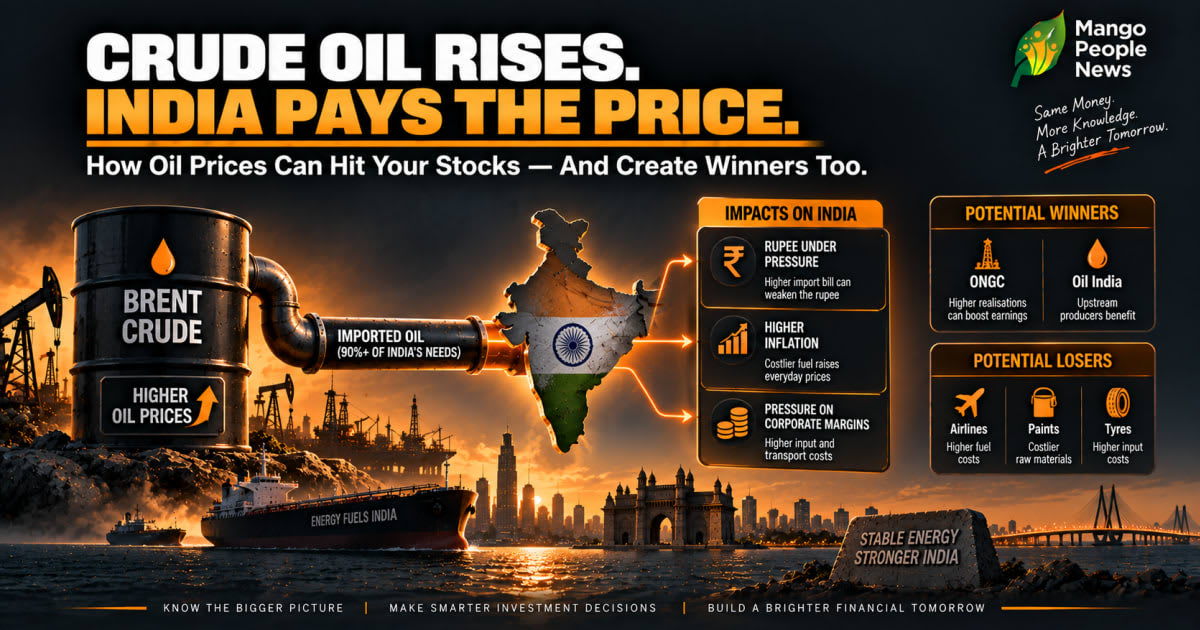
This isn't a small technical detail — it's the reason oil functions almost like a "tax" India pays to the rest of the world every single day, in US dollars, regardless of what's happening in the domestic economy. Because international crude is priced and settled in dollars, every sustained move in the oil price ripples through India's macroeconomy along three connected channels:
1. A widening trade deficit.
A trade deficit is simply the gap between what a country buys from the world and what it sells to the world. When oil prices rise, India has to spend significantly more of its foreign exchange reserves to import the exact same volume of fuel — money that isn't going toward productive investment at home.
2. Currency depreciation.
To pay a bigger oil bill in dollars, Indian oil companies and the government need to buy more dollars in the open market. That extra demand for dollars — and corresponding supply of rupees — pushes the rupee's value down. The rupee has already declined more than 3% against the dollar in 2026, a move that analysts have directly linked to sustained high crude prices.
3. Imported inflation.
Diesel is the lifeblood of India's freight and transport network — trucks carrying vegetables, cement, steel, and finished goods all run on it. When diesel prices rise, transportation costs rise across virtually every product category, pushing up headline Consumer Price Index (CPI) inflation — the most-watched measure of how expensive daily life is becoming.
The 2026 Stress Test
This isn't theoretical this year — 2026 has been a live demonstration of exactly this mechanism. Brent crude spiked as high as $120.88 per barrel in April 2026 amid escalating tensions in the Middle East, and by early September, renewed Strait of Hormuz disruptions and Iran-linked attacks on refineries pushed Brent back up to around $97.5 per barrel — a six-week high and roughly 40% above pre-conflict levels. Roughly 7 million barrels a day of crude still moves through the Strait of Hormuz, a narrow shipping corridor between Iran and Oman that carries a fifth of global oil supply — which is exactly why any threat to it moves markets worldwide within hours.
India's own oil-import bill tells the flip side of this story too. During a stretch of softer prices earlier in the year, India's combined oil-and-gas import bill actually fell 12% year-on-year in the April–October period, saving the country billions of dollars simply because Brent had dropped to an average of about $65 per barrel. The lesson: the exact same import volume can cost India dramatically more or less, purely based on a global price it doesn't control.
Which Sectors Take the Direct Hit?
Crude oil isn't just a fuel cost — it's a raw material embedded across a surprisingly wide swath of Indian industry, through petrochemicals derived from it.
Paints & Adhesives: Roughly 40–50% of the raw materials used to manufacture paints are petroleum derivatives. Higher crude directly compresses operating margins unless companies can raise prices to offset it.
Aviation: Aviation Turbine Fuel (ATF) typically accounts for 30–40% of an airline's total operating expenses — making airline stocks some of the most directly crude-sensitive names on the exchange.
Tyres & Synthetic Rubber: These industries rely heavily on petrochemical feedstocks (raw chemical inputs derived from crude), so rising oil prices squeeze input costs in a similar way to paints.
Logistics & Auto: High fuel pump prices raise trucking and operating costs for logistics companies, while also discouraging discretionary vehicle usage and, over time, new vehicle purchases.
It's worth noting that crude isn't uniformly bad news for every Indian company. Upstream producers like ONGC and Oil India, whose revenue is linked to international crude realizations, actually benefit when prices rise. Oil Marketing Companies (OMCs) like IOCL, BPCL, and HPCL sit in a trickier spot in between — they buy crude at global prices but don't always get to pass the full cost on to consumers at the pump, especially when the government wants to control retail fuel inflation ahead of elections or during high-inflation periods, which can squeeze their margins.
Why the Panic Often Overshoots the Damage
Here's a nuance worth understanding: India's actual economic sensitivity to oil has structurally reduced over the past decade, even as headline import dependence has risen. Crude imports as a share of India's GDP have nearly halved — from about 9% in 2013 to around 4.8% today — because the overall economy has grown so much larger and more diversified. That means a given oil price spike inflicts proportionally less damage on India's economy today than the identical spike would have a decade ago, even though the country now imports a larger percentage of a larger total requirement.
This helps explain a pattern analysts have repeatedly observed in 2026: benchmark indices have "held up better than many expected" even as Brent spiked well above $110–115 per barrel for extended stretches. The initial market reaction to any oil-price shock is usually driven by immediate panic and headline-reading — "oil at multi-year highs" makes for a dramatic headline — rather than a careful recalculation of actual earnings impact across India Inc.
What Does It Mean for Me?
Crude volatility is a permanent feature of investing in India, not a temporary anomaly. As long as India imports the large majority of its oil, geopolitical events anywhere from the Strait of Hormuz to the Red Sea will periodically move Indian markets. Building this expectation into your investing mindset is more useful than being surprised by it each time.
Watch the level and the duration together, not just the headline spike. A brief spike to $120 driven by a specific geopolitical event tends to fade once the immediate crisis eases — as happened through 2026's multiple oil shocks. What genuinely threatens India's macro stability is crude staying elevated above roughly $95–$100 for multiple consecutive quarters, since that's long enough to meaningfully widen the trade deficit and feed into sustained inflation.
Check which side of the crude trade a stock sits on before reacting to an oil headline. A blanket "oil is up, sell everything" reaction ignores that upstream producers benefit from the same move that hurts airlines, paint makers, and tyre companies. Understanding your specific holdings' actual exposure matters more than reacting to the commodity price alone.
Oil-led dips have historically created entry points in quality franchises with temporary, not structural, damage. When a strong domestic business — with real pricing power and a fundamentally sound balance sheet — falls purely because of a broad, oil-driven market correction, that gap between a temporary macro scare and the company's actual long-term earning power is often exactly where patient, long-term investors find their best entries.
The One-Line Takeaway
India's growth story runs on imported energy, which means crude oil will keep intruding into stock market headlines for the foreseeable future — but distinguishing a short, sharp geopolitical scare from a genuine multi-quarter structural shock is what separates a panicked sale from a smart purchase.

Nikunjj Jhawar is a Chartered Accountant (CA) and Chartered Financial Analyst (CFA) with nearly two decades of experience in the financial services industry. Having worked with global institutions such as HSBC and Credit Suisse in investment-related roles, he brings deep expertise in finance and markets. He is the Founder of mangopeoplenews.com, where he focuses on making complex topics in finance, markets and business accessible and relevant to everyday readers.