What Happens to Indian Stocks When the RBI Changes Interest Rates?
Six times a year, a committee of six economists meets in Mumbai for three days and announces a single number. That number — the Repo Rate — quietly shapes your home loan EMI, your fixed deposit returns, and the direction of your stock portfolio, often more powerfully than any company-specific news you'll read that week.
The Repo Rate is simply the interest rate at which the Reserve Bank of India (RBI) lends short-term money to commercial banks. As of the RBI's August 2026 Monetary Policy Committee (MPC) meeting, the repo rate stands at 5.25% — held steady for the fourth consecutive review, after a cumulative 100-basis-point cut through late 2025. It sounds like a technical, almost boring number. But few macroeconomic levers touch as much of your financial life at once as this one figure does.
The Mechanical Domino Effect
The RBI's logic is straightforward: when inflation runs hot, it hikes rates to cool the economy down by making borrowing more expensive. When growth slows, it cuts rates to make borrowing cheaper and encourage spending. From there, the effects cascade through the economy in three distinct, connected ways.
1. Borrowing costs for India Inc
Companies that carry floating-rate loans — where the interest rate moves with the repo rate — see their interest expense change almost immediately. A rate hike eats directly into net profit margins, since more of the company's revenue now goes toward servicing debt rather than reinvestment or shareholder returns. A rate cut works in reverse, freeing up cash flow.
2. Consumer wallets shrink or expand
When the RBI raises rates, banks eventually raise home loan and car loan EMIs. Households facing a higher EMI have less disposable income left for discretionary spending — the new smartphone, the weekend restaurant visit, the vacation. This is why FMCG (fast-moving consumer goods) and retail-linked sectors often feel a rate hike's pinch with a lag of a few months, once the higher EMI actually shows up on borrowers' bank statements.
3. Valuation math shifts under every stock
This is the least intuitive effect, but arguably the most important for stock prices. Analysts value a stock today by estimating all the cash it will generate in future years and "discounting" that future cash back to a present value — using the risk-free interest rate (typically government bond yields) as the benchmark for that discounting. When the risk-free rate rises, that same future cash flow is worth less in today's terms, purely because of the math — even if the company's actual business hasn't changed at all. This is why entire stock markets can wobble on an interest rate announcement, independent of any single company's quarterly results.
Sector Winners and Losers
Because different sectors depend on debt to different degrees, rate cycles don't affect the whole market equally. They create clear winners and laggards.
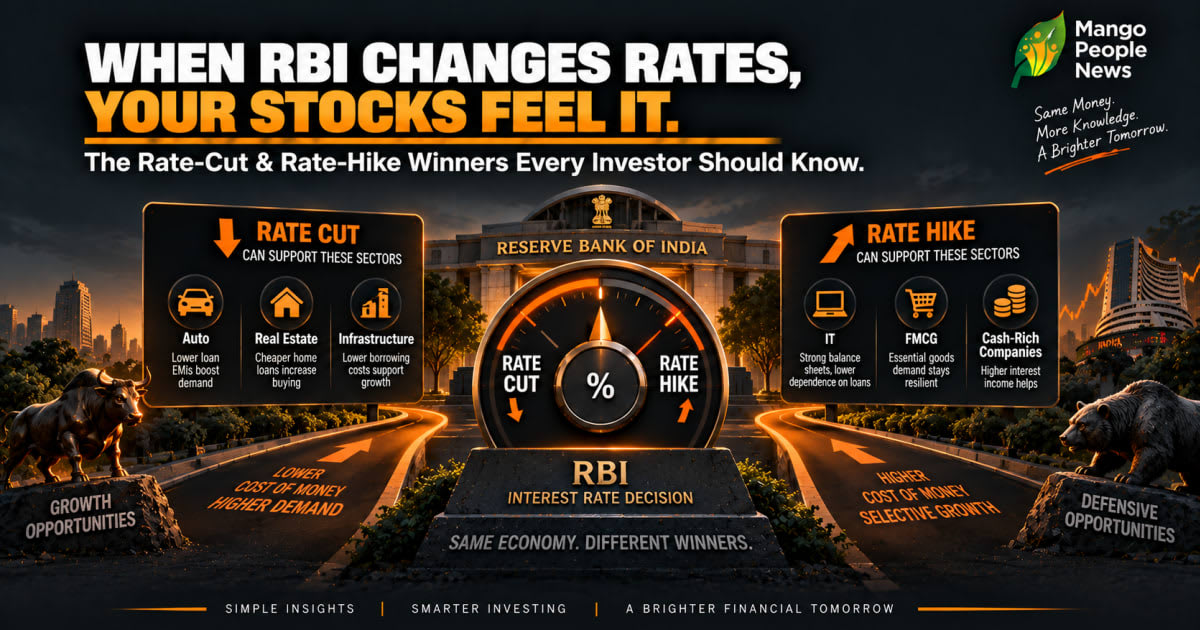
Rate-cut winners — sectors that run on borrowed money:
Auto: Most vehicle purchases in India are financed. Cheaper car and two-wheeler loans directly boost sales volumes.
Real Estate: Home loan affordability is the single biggest driver of housing demand. A lower EMI on the same loan amount can be the difference between "just browsing" and "signing the papers."
Capital Goods and Infrastructure: These businesses carry large project loans and benefit enormously when the cost of that capital falls, improving project economics and encouraging fresh capital expenditure.
Rate-hike defensives — businesses that don't need the bank:
Cash-rich, low-debt large IT firms: Companies like the top IT services majors carry minimal debt and generate strong free cash flow, so a higher repo rate barely dents their profitability. Their challenge in a high-rate world comes from client budgets abroad, not their own borrowing costs.
Top FMCG majors: Established consumer giants with strong balance sheets and pricing power can navigate a high-rate, high-EMI environment far more comfortably than smaller, debt-heavy consumer companies competing on price.
Reading the Cycle Correctly
It's worth understanding what an RBI rate decision actually reflects, because that context changes how you should react to it. At its June and August 2026 meetings, for instance, the RBI held rates steady at 5.25% not because the economy was struggling, but because it wanted "greater clarity" on inflation — flagging risks like the West Asia conflict, volatile crude oil prices, and an uneven monsoon, while simultaneously raising its FY27 GDP growth forecast to 6.7%. In other words, a "pause" or even a "hold" doesn't automatically signal weakness — it can just as easily reflect a central bank being deliberately cautious while the underlying economy stays resilient. Reading only the headline ("rates unchanged") without the RBI's stated reasoning is how many investors misjudge the moment.
What Does It Mean for Me?
Interest rate cycles are mean-reverting. Rates rise and fall over multi-year periods — they don't move in one direction forever. India's own recent history shows a hiking phase, a plateau, and then a cutting phase, cumulatively bringing the repo rate down from 6.5% to 5.25% between February 2025 and December 2025 before pausing. Reacting to a single rate decision as if it defines the next decade is a mistake most seasoned investors have learned to avoid.
Never sell your equity mutual funds simply because the RBI raised rates. A single hike doesn't undo a company's underlying business quality. Selling out of panic during a hiking cycle, and buying back in once headlines feel comfortable again, is one of the most reliable ways retail investors lock in losses that a patient holder never would have realized.
A rate-hike cycle often does useful, if uncomfortable, work. Higher borrowing costs squeeze out businesses that were relying on cheap debt rather than genuine profitability to survive. What's left standing after a tightening cycle — companies with real cash flow, manageable debt, and pricing power — are often exactly the businesses that lead the next bull run.
Use sector context, not just the headline rate, to set expectations. If you hold auto, real estate, or infrastructure stocks, a rate cut cycle is a genuine tailwind worth understanding. If you hold IT or established FMCG names, rate moves matter far less to their fundamentals than currency trends or global demand.
The One-Line Takeaway
A single RBI rate decision changes the cost of money for the entire economy at once — but it's a cycle, not a verdict. Understand which sectors benefit and which defend well in each phase, and resist the urge to make permanent portfolio decisions based on one meeting's announcement.

Nikunjj Jhawar is a Chartered Accountant (CA) and Chartered Financial Analyst (CFA) with nearly two decades of experience in the financial services industry. Having worked with global institutions such as HSBC and Credit Suisse in investment-related roles, he brings deep expertise in finance and markets. He is the Founder of mangopeoplenews.com, where he focuses on making complex topics in finance, markets and business accessible and relevant to everyday readers.