India Defence Sector Explained: Players, Deals & Growth
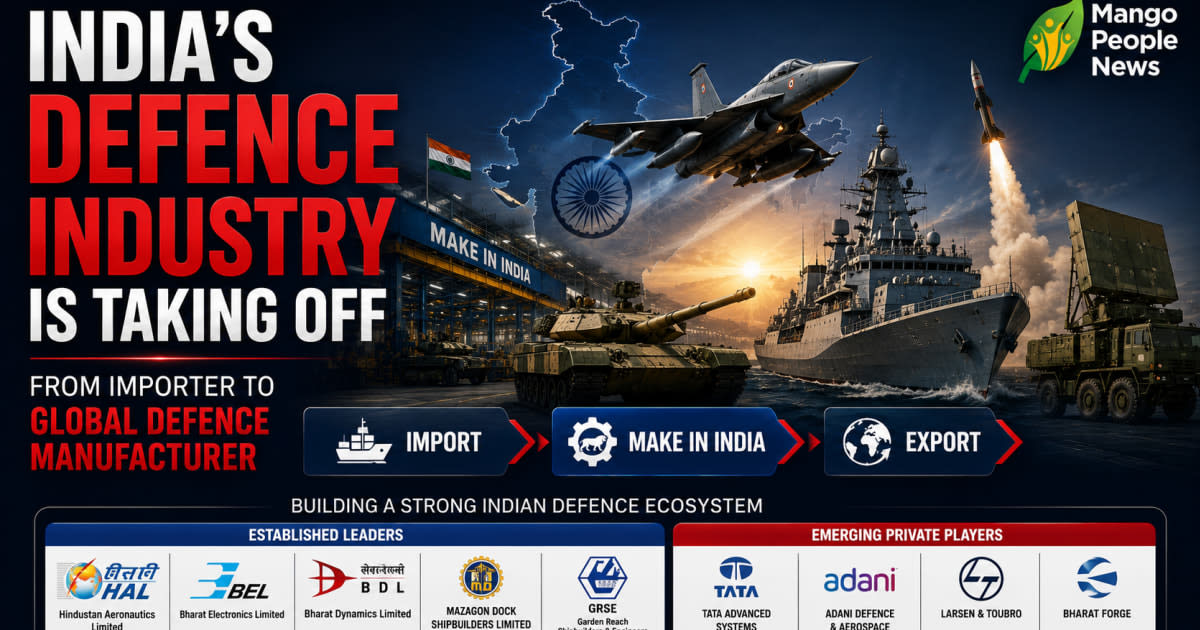
For most of independent India's history, the country was known as one of the world's biggest buyers of foreign weapons — tanks from Russia, fighter jets from France, rifles from Israel. Today, that picture is changing fast. India's defence factories produced goods worth ₹1.78 lakh crore in FY26 (the year ending March 2026), and the country now sells military equipment to more than 80 nations. This is the story of how that shift happened, who is building India's weapons today, and where the industry is headed next.
A Brief History: From British-Era Ordnance Factories To A Self-Reliant Ambition
India's defence manufacturing story doesn't start in 1947 — it starts almost 250 years earlier. The British set up the Board of Ordnance in Kolkata in 1775, followed by a gunpowder factory in 1787, mainly to arm their colonial army. By independence, India had inherited a network of these ordnance factories, along with organisations like the Ordnance Factory Board (OFB) that ran them.
The real turning point came after India's humiliating defeat in the 1962 war with China. The government sharply raised defence spending — from 1.5% of the country's total economic output (GDP) to 2.3% — and set up the Defence Research and Development Organisation (DRDO) to build indigenous weapons technology. Three years later, after the 1965 war with Pakistan, the United States placed an arms embargo on India. That pushed India firmly into the arms of the Soviet Union, which supplied — and helped India begin manufacturing under licence — the bulk of its military hardware for the next few decades.
For most of this period, defence production was almost entirely a government monopoly, run through DRDO's laboratories, the Ordnance Factory Board's factories, and a handful of large public sector companies like Hindustan Aeronautics Limited (HAL) and Bharat Electronics Limited (BEL). Private Indian companies were largely locked out.
That began to change only after 2001, when the government first allowed private firms to manufacture defence equipment. Foreign investment rules were eased too — foreign companies could own up to 26% of an Indian defence firm in 2001, then 49% in 2014, and finally up to 74% (with government approval) from 2020 onwards. This mattered because global defence giants like Airbus, Lockheed Martin and Boeing were far more willing to share advanced technology once they could hold a meaningful ownership stake in their Indian partnerships.
The biggest structural change came in 2021, when the government dissolved the 250-year-old Ordnance Factory Board altogether. Its 41 factories, which had been running as a single government department, were split into seven independent, corporatised companies — each focused on one area, such as ammunition and explosives, combat vehicles, or weapons and equipment. The idea was simple: a government department doesn't have to chase profit or efficiency, but a company does.
How Defence Production Has Grown Over The Years
Numbers tell this story better than words. In 2014, India's total annual defence production stood at around ₹46,000 crore. By FY26, it had crossed ₹1.78 lakh crore — a nearly four-fold increase in just over a decade, and a 110% jump since FY21 alone. To put that in everyday terms: India's defence factories are now producing, every single year, goods worth almost enough to fund four Mumbai Metro rail networks.
Public Vs Private: Who Makes What Share?
Government-owned companies — the Defence Public Sector Undertakings (DPSUs) and the seven new corporatised ordnance factory units — still dominate, accounting for about 76% of total production in FY26. But the private sector's share has been climbing steadily, from 22% in FY25 to a record 24% in FY26, translating to roughly ₹42,000 crore worth of weapons, components and systems built by private Indian companies in a single year.
This growth hasn't happened by accident. India's defence budget itself has swelled — from ₹2.53 lakh crore in FY14 to ₹7.85 lakh crore in FY27 — and a Defence Acquisition Procedure rule now requires that at least 75% of the money set aside for buying new equipment (not salaries or pensions) must be spent on Indian-made products. That single rule guarantees Indian manufacturers, government and private alike, a locked-in customer base worth well over ₹1.3 lakh crore every year.
Who Are The Major Players? Government And Private, Explained Simply
The Government Giants (DPSUs)
Hindustan Aeronautics Limited (HAL): India's aircraft-maker, building the indigenous Tejas fighter jet, Dhruv and Rudra helicopters, and repairing much of the Air Force's Russian-origin fleet. HAL's order book stretches all the way to 2034 and is worth over ₹2.6 lakh crore, anchored by an ₹48,000 crore order for 83 Tejas Mk-1A jets.
Bharat Electronics Limited (BEL): India's largest defence electronics company, making radars, electronic warfare systems and battlefield communication equipment, with a record order book of roughly ₹75,000 crore.
Bharat Dynamics Limited (BDL): India's only dedicated missile manufacturer, producing the Akash air-defence system, Astra air-to-air missiles, and MRSAM systems for the Army, Navy and Air Force.
Mazagon Dock Shipbuilders and Garden Reach Shipbuilders (GRSE): These state-owned shipyards build the Navy's submarines, destroyers and frigates — including the ongoing Project-75 Alpha submarine programme.
The Seven New DPSUs: Formed from the old Ordnance Factory Board, these companies — with names like Advanced Weapons and Equipment India Limited and Yantra India Limited — now manufacture everything from tank ammunition to rifles and military vehicles.
The Private Sector Challengers
Tata Advanced Systems (TASL): The Tata Group's dedicated aerospace and defence arm, and arguably India's most active private defence manufacturer. It builds aerostructures for global giants like Airbus and Boeing, and is the Indian production partner for the C-295 military transport aircraft.
Adani Defence & Aerospace: A relatively new but fast-growing entrant, now manufacturing drones, ammunition and has been shortlisted for India's most ambitious fighter jet programme.
Larsen & Toubro (L&T): A long-time defence supplier building artillery systems, missile launchers and warship components, alongside its core infrastructure and engineering business.
Bharat Forge / Kalyani Strategic Systems: Part of the Kalyani Group, this Pune-based manufacturer specialises in artillery guns, armoured vehicles and forged components for missiles.
Mahindra Defence Systems: Part of the Mahindra Group and, by the company's own account, India's largest private-sector supplier of defence systems to the government. It builds armoured vehicles like the Armado (used by Indian Army units on UN peacekeeping missions), underwater warfare equipment such as anti-submarine defence suites for Navy warships, and surveillance systems — with over 70 years of engineering history behind it.
Reliance Group: Mukesh Ambani's Reliance Industries and the separate Reliance Infrastructure-linked defence arm have both been building out a defence portfolio through partnerships rather than in-house development — including tie-ups with France's Dassault Aviation, Germany's Rheinmetall and Diehl Defence, and, most recently, British engine major Rolls-Royce.
Data Patterns, Paras Defence, Astra Microwave, Zen Technologies: A newer generation of smaller, listed private defence companies focused on niche, high-tech areas like electronic warfare, radars, counter-drone systems and simulation-based training.
Big Joint Ventures And Tie-Ups In Recent Years
Rather than building everything from scratch, Indian companies — both government and private — have increasingly partnered with global defence majors to access advanced technology quickly. Here are some of the biggest recent examples:
Tata-Airbus: Making Military Transport Planes In India
Tata Advanced Systems was chosen as Airbus's Indian production partner for the C-295 medium-lift military transport aircraft. Under the deal, 16 aircraft were imported ready-made, while 40 more will be built entirely in India at a new final assembly line in Vadodara, Gujarat — the first genuinely "Made in India" military aircraft of its kind, expected to roll out in September 2026.
Tata-Lockheed Martin: Building Parts For America's Workhorse Aircraft
Through a joint venture called Tata Lockheed Martin Aerostructures Limited, Tata now manufactures tail assemblies (called empennages) for the C-130J Super Hercules military transport aircraft — a plane used by the US Air Force and dozens of other militaries around the world. The venture recently delivered its 250th such unit.
Tata-Raytheon-Lockheed Martin: Javelin Anti-Tank Missiles
In a more recent development, a Tata Group company has partnered with a joint venture between US defence giants Raytheon and Lockheed Martin to manufacture Javelin anti-tank guided missiles — a weapon that gained global recognition during its use in the Russia-Ukraine war.
Ordnance Factory Board-Kalashnikov: India's New Assault Rifle
One of the more unusual joint ventures saw the erstwhile Ordnance Factory Board team up with Russia's Kalashnikov Concern (the maker of the legendary AK-47) and Rosoboronexport to manufacture AK-203 assault rifles in Amethi, Uttar Pradesh, for India's armed forces and police.
The Race For India's Stealth Fighter Jet
Perhaps the most closely watched tie-up isn't finalised yet. For the Advanced Medium Combat Aircraft (AMCA) — India's first indigenous stealth fighter jet — the Aeronautical Development Agency invited both government and private companies to bid for the contract to build prototypes. HAL, Tata Advanced Systems, L&T, Adani Defence and Bharat Forge/Kalyani have all thrown their hats in the ring, marking the first time a fighter jet programme of this scale has been opened up to competition between the public and private sector, rather than being handed directly to HAL.
Reliance-Rolls-Royce: Chasing India's First Homegrown Fighter Jet Engine
In August 2026, Reliance Industries and British aero-engine maker Rolls-Royce announced their intent to jointly build a sovereign, indigenous combat engine for the same AMCA fighter jet programme. The two companies plan to set up a dedicated "Aerospace Gas Turbine Complex" in India — a facility meant to handle the entire life cycle of engine-making, from design and testing to manufacturing and after-sales support. This matters because engine technology has long been India's biggest weak spot: the country has built its own tanks, missiles and even fighter jet frames, but has never successfully built a modern fighter jet engine from scratch. It's worth noting this is currently a "strategic intent" to partner, not a confirmed government contract — France's Safran, working with government-run DRDO, is pursuing a rival proposal for the same engine requirement. Separately, Reliance's infrastructure arm has also tied up with Germany's Diehl Defence to locally produce precision-guided munitions, adding to earlier partnerships with Dassault Aviation and Rheinmetall.
Adani-Leonardo: Building India's Helicopter Manufacturing Base
In February 2026, Adani Defence & Aerospace signed an agreement with Italian aerospace major Leonardo to jointly develop, manufacture and maintain military helicopters in India, with an initial focus on Leonardo's AW169M and AW109 TrekkerM models for the Indian Navy. The scale of opportunity here is large: India's armed forces are projected to need more than 1,000 helicopters over the next decade, across everything from light utility choppers to maritime multi-role aircraft. The partnership covers not just manufacturing but also maintenance, repair and overhaul work, plus pilot training — the kind of full-service ecosystem that could keep helicopters flying for decades after they're first built.
Exports: India Is Now Selling Weapons To The World
Perhaps the most striking change is on the export side. In FY14, India's defence exports were worth barely ₹686 crore. By FY26, that figure had rocketed to ₹38,424 crore — a jump of more than 55 times in just over a decade. India now has 145 licensed defence exporters selling to over 80 countries, up from a time when India barely exported any weapons at all.
Some of the standout export stories: the Philippines has bought India's BrahMos supersonic cruise missile — the country's first major defence export contract of that scale. HAL's Tejas fighter jet has drawn interest from Egypt, Malaysia and Argentina. And BEL's radar and missile systems have found buyers in countries like Mauritius, Sri Lanka and Armenia.
Future Potential: Where Is The Industry Headed?
The government has set two clear numerical goals for 2029: defence production worth ₹3 lakh crore (nearly double today's level), and defence exports worth ₹50,000 crore. Achieving that first target alone would mean building on an already-record base at a pace even faster than the last five years. A few developments will likely shape whether India gets there:
Engine technology, finally coming home: For decades, India's biggest weakness has been its inability to build advanced jet engines domestically. That is starting to change, with American company GE Aerospace agreeing to manufacture GE-414 engines — used in the upgraded Tejas Mk-2 fighter — on Indian soil, transferring a meaningful amount of technology in the process.
Dedicated defence industrial corridors: The government has set up two dedicated defence manufacturing clusters — one in Uttar Pradesh, one in Tamil Nadu — designed to pool infrastructure, skilled workers and suppliers in one place, the same way IT parks helped build India's software industry.
Startups entering the arena: Through a government initiative called iDEX (Innovations for Defence Excellence), dozens of small startups are now getting direct government funding and access to the armed forces to test new technology — everything from battlefield drones to AI-based surveillance tools — a sharp break from the old model where only giant PSUs got a seat at the table.
A widening list of what must be built in India: The government has issued multiple "Positive Indigenisation Lists" — now covering more than 5,500 items — which simply cannot be imported after a set deadline, forcing the armed forces to buy them from Indian manufacturers only. Every new list forces both PSUs and private players to build fresh manufacturing capability.
Taken together, India's defence industry looks less like a slow-moving government department today and more like a genuine growth sector — one where global technology partnerships, an expanding private sector, and a guaranteed domestic customer in the armed forces are combining to turn a former arms importer into a credible global arms supplier. Whether the industry can sustain this pace, deliver complex platforms like the AMCA fighter jet on time, and keep winning export orders in a competitive global market will determine how close India gets to its 2029 targets.

Nikunjj Jhawar is a Chartered Accountant (CA) and Chartered Financial Analyst (CFA) with nearly two decades of experience in the financial services industry. Having worked with global institutions such as HSBC and Credit Suisse in investment-related roles, he brings deep expertise in finance and markets. He is the Founder of mangopeoplenews.com, where he focuses on making complex topics in finance, markets and business accessible and relevant to everyday readers.