HCLTech Is No Longer Just an IT Services Company: Inside the AI, Data Centre, and Semiconductor Bets That Are Redefining India's Third-Largest IT Giant

A Company in Deliberate Transformation
There is a version of HCLTech that most people know: India's third-largest IT company by revenue, strong in engineering services and infrastructure management, dependable rather than dazzling, a company that competes on execution discipline rather than market-moving announcements.
That version is being quietly but systematically retired. In the past six weeks alone, HCLTech has made its largest-ever investment in an Indian AI startup, committed ₹3,500 crore to build its own data centre infrastructure, posted its highest-ever quarterly profit, and laid the foundation stone for a semiconductor manufacturing unit with Foxconn that Prime Minister Modi attended personally.
These are not incremental moves at the margin of an existing business. They are the architecture of a different company — one that intends to compete not just on IT services delivery but on AI technology ownership, compute infrastructure, and domestic semiconductor manufacturing.
Q1 FY27 Results — Record Profit, Strong Margins, Dividend Raised
Start with what the business is actually delivering before turning to what it is building toward.
HCLTech reported net profit of ₹4,624 crore in Q1 FY27, up 20% year-on-year (Planet 9 Productions) — the highest quarterly net profit in the company's history. Revenue grew 8.5% year-on-year in constant currency terms. EBIT margin improved to 19.5% — above the company's guided range and well ahead of most analyst expectations. The board declared a dividend of ₹12 per share for the quarter.
The Q1 performance is significant because it arrives in the middle of a period when the broader Indian IT sector has been grappling with slower decision cycles and client caution around discretionary technology spending. HCLTech growing profit 20% in that environment — while simultaneously making ₹1,427 crore in strategic AI investments and committing ₹3,500 crore to data centre infrastructure — demonstrates the financial strength underlying its transformation ambition. This is not a company cutting costs to fund bets. It is a company generating cash from a strong core business while simultaneously building the next version of itself.
The Sarvam AI Bet — ₹1,427 Crore for India's Most Valuable AI Startup
The Sarvam AI investment is the most strategically significant single transaction HCLTech has made in years — and arguably the most important bet by any Indian IT major on the domestic AI ecosystem.
HCLTech agreed to acquire a 10.5% stake in domestic generative AI startup Sarvam AI for ₹14.27 billion ($150.7 million) in cash, leading the firm's Series B round as a strategic investor. Sarvam was valued at $1.5 billion in the round, which raised $234 million in its first close out of a targeted $300 million. The investment is part of Sarvam's Series B funding round. Along with HCLTech, Bessemer Venture Partners joined the round, while existing investors including Khosla Ventures and Peak XV Partners continued their support.
Sarvam is not a typical Indian AI startup. It does not build applications on top of ChatGPT or Claude. It builds its own foundation models — from scratch, with a specific focus on Indian languages, Indian regulatory requirements, and the specific needs of Indian enterprise and government clients. Sarvam's products are focused on the verticals where the stakes are highest: banking, insurance, govtech, and defence. Sarvam's conversational platform now handles over 2 million interactions a day, with usage doubling in the last two months. Sarvam's models are also being adopted by developers served on its inference platform in India which processes 10 million API calls daily, with usage tripling in the last three months.
The scale of Sarvam's actual deployments is the detail that distinguishes it from the many Indian AI startups that have impressive technology but limited real-world usage. With multilingual voice agents, Sarvam's platform collected high-quality data from 17 million farmers providing deep insights to the Ministry of Agriculture and Farmer's Welfare. A system handling 17 million farmer interactions at government scale is not a proof-of-concept. It is production AI serving a genuinely large-scale public need.
What does HCLTech get from this investment beyond a 10.5% equity stake?
The investment will allow the Indian IT services company to develop specific language models and AI solutions for its global client base, and accelerate the development of sovereign AI solutions for governments and regulated industries.
That phrase — "sovereign AI solutions for governments and regulated industries" — is the commercial opportunity that explains the strategic logic. Governments in India and globally are increasingly uncomfortable with AI systems that process sensitive citizen data through foreign-owned models hosted on foreign infrastructure. A combination of HCLTech's enterprise delivery capability, its global government relationships, and Sarvam's India-built, India-hosted AI models creates a proposition for sovereign AI deployment that neither company could credibly offer alone.
C Vijayakumar, CEO & Managing Director of HCLTech said the investment marks a significant milestone in their AI transformation journey. By combining HCLTech's deep enterprise transformation expertise, trusted global client relationships, data and other software IP, and engineering depth, it would accelerate Sarvam's goal of building a powerful, end-to-end sovereign AI ecosystem for India and beyond.
The ₹3,500 Crore Data Centre Commitment — Building the Physical AI Stack
The Sarvam AI investment gives HCLTech access to frontier AI models. But models need compute infrastructure to run. That is where the data centre investment completes the logic.
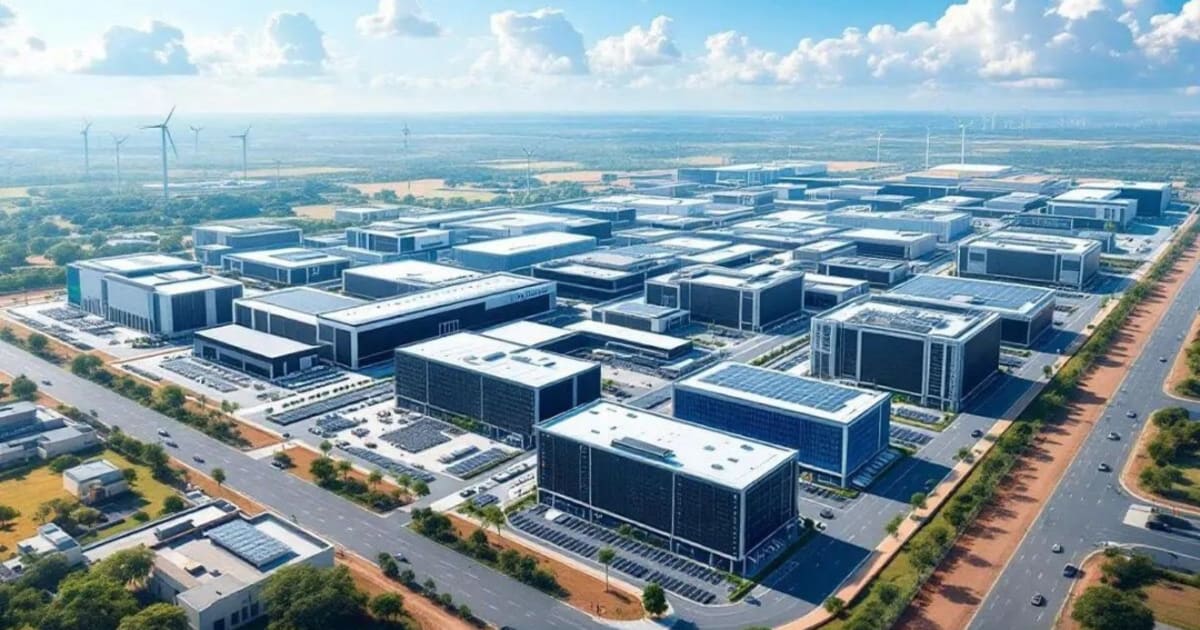
HCLTech plans to invest ₹3,500 crore to enter the AI infrastructure business by building its own data centres, under a new venture called HyperVault. HyperVault is conceptually ambitious: HCLTech is not proposing to rent space in someone else's data centre and resell it. It is building its own dedicated AI compute infrastructure — what the industry calls a "HyperVault" to distinguish it from a conventional colocation data centre. The name signals the intent: a secure, sovereign, AI-optimised compute environment for enterprise and government clients who want the power of frontier AI but cannot place their data on hyperscaler infrastructure for compliance or security reasons.
The market timing is precise. India's data centre capacity is expanding from 1.9 GW to a projected 9-15 GW by 2031. Every percentage point of that expansion that HCLTech captures through HyperVault represents recurring infrastructure revenue that is fundamentally different in character from the time-and-material services revenue that has historically defined Indian IT economics. Infrastructure revenue compounds as utilisation rises. Services revenue is linear with headcount.
The combination of Sarvam's AI models and HyperVault's compute infrastructure creates a full-stack AI product for enterprise clients: proprietary models trained on Indian data, running on proprietary infrastructure, delivered through HCLTech's global enterprise relationships. That is a distinctly different pitch from "we will help you implement someone else's AI using someone else's compute."
The Foxconn Semiconductor JV — PM Modi Lays the Foundation Stone
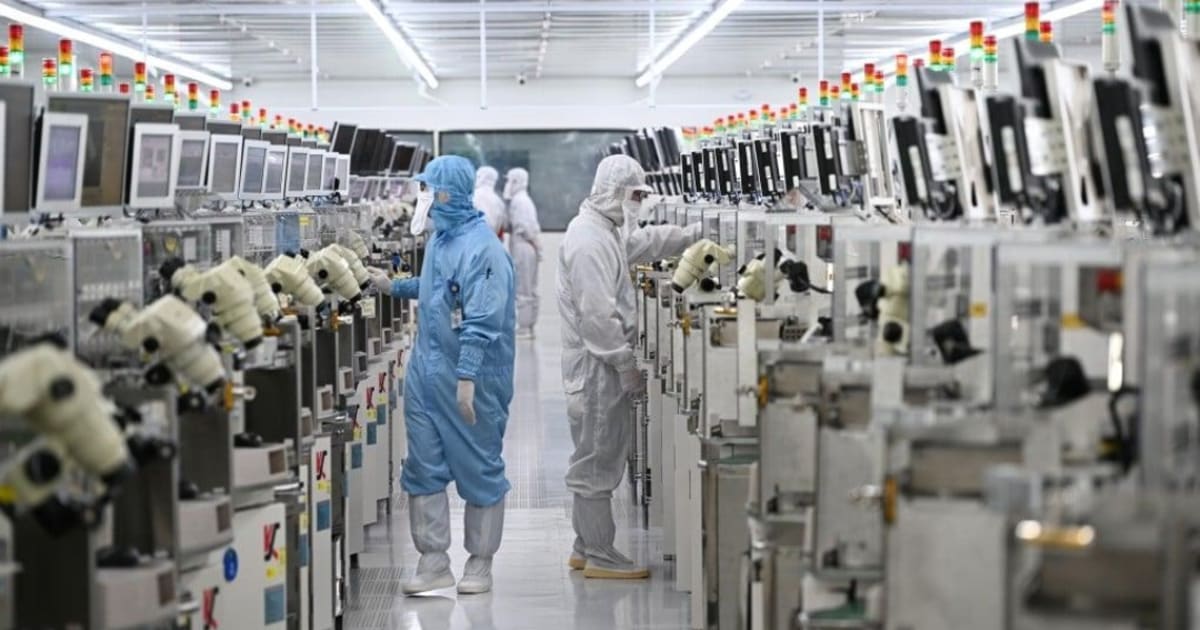
The third pillar of HCLTech's transformation is also the most long-dated: a semiconductor manufacturing joint venture with Foxconn in Uttar Pradesh. PM Modi laid the foundation stone for the HCL-Foxconn semiconductor unit in Uttar Pradesh, marking a major step in India's push to develop domestic chip manufacturing capabilities.
The HCL-Foxconn joint venture is for OSAT — Outsourced Semiconductor Assembly, Testing, and Packaging — rather than wafer fabrication. This distinction matters. Advanced semiconductor fabrication (the kind TSMC does) requires decades of accumulated expertise, billions of dollars of specialised equipment, and ultra-clean manufacturing environments at the frontier of what physical science can currently achieve. OSAT — taking finished silicon dies from a foundry and packaging, testing, and integrating them into final chips — is considerably more accessible, and is where India has focused its semiconductor mission.
The UP facility will manufacture chips for display drivers, microcontrollers, and power management ICs — the categories of semiconductors most extensively used in consumer electronics, automotive applications, and industrial devices. These are not cutting-edge AI training chips; they are the workhorse components that go into virtually every electronic product manufactured in India.
The strategic logic for HCLTech is different from the obvious: this is not about HCLTech becoming a chip manufacturer. It is about HCLTech building a capability in semiconductor services — testing, packaging, supply chain management — that creates a new service category for a client base that will increasingly want a trusted Indian technology partner to manage the semiconductor supply chain alongside their software and IT services. A client running manufacturing operations in India that needs chip procurement, testing, and supply chain management as well as IT services has a natural reason to consolidate both with HCLTech. The Foxconn JV creates that bundle.
How the Three Bets Fit Together
The three moves — Sarvam AI, HyperVault data centres, Foxconn semiconductors — are not unrelated strategic experiments. They are three layers of a single integrated ambition.
The foundation layer is hardware: semiconductors manufactured in UP. The infrastructure layer is compute: HyperVault data centres running AI workloads. The intelligence layer is software: Sarvam's AI models processing natural language, documents, and voice across Indian languages.
A company that owns all three layers — from chip packaging through compute infrastructure to AI model deployment — is not an IT services company in any traditional sense. It is a technology stack company, competing with a fundamentally different commercial proposition than the one HCLTech built its first four decades on.
The comparison that suggests itself is what Tata Consultancy Services is attempting with its HyperVault equivalent — TCS has announced 1 GW of data centre build — or what Infosys is trying with its AI Cloud offering. All three of India's largest IT companies are making variants of the same strategic bet: that pure services will not sustain premium valuations in an AI-first world, and that technology ownership — in compute, in models, in proprietary IP — is the path to escaping the commoditisation that has periodically haunted Indian IT margins.
HCLTech's particular version of this bet has some specific advantages. The Sarvam investment — rather than building AI models entirely in-house — buys into a startup that has already achieved real-scale deployment at 2 million daily interactions and 10 million API calls daily, rather than starting from zero. The HyperVault data centre business builds on HCLTech's existing infrastructure services business, which already manages thousands of servers and data centre environments for clients. And the Foxconn JV leverages Foxconn's manufacturing expertise alongside HCLTech's technology services, rather than attempting to build semiconductor manufacturing capability entirely from scratch.
The Financials — Can the Core Business Fund the Transformation?
The most important financial question about HCLTech's transformation is whether the profitability of the existing IT services business can fund these three simultaneous strategic bets without requiring dilutive equity raises or compromising financial discipline.
The Q1 FY27 numbers suggest the answer is yes — at least for now. A ₹4,624 crore quarterly net profit provides meaningful internal capital generation. The ₹3,500 crore data centre investment spread over multiple years can be funded from operating cash flows without straining the balance sheet. The ₹1,427 crore Sarvam investment, while substantial as a single transaction, is manageable against a company with the cash generation profile HCLTech has demonstrated.
The dividend of ₹12 per share alongside these strategic investments signals that management believes the core business is generating enough cash to simultaneously reward shareholders and fund transformation — the discipline signal that institutional investors needed to see before endorsing the strategy.
Revenue has grown 8.5% in constant currency in Q1 — below what the AI transformation narrative might imply is achievable. The honest assessment is that the revenue contribution from Sarvam, HyperVault, and the semiconductor JV is years away from being material in the context of a ₹1,20,000+ crore annual revenue base. These are investments in position rather than investments in near-term earnings accretion.
The Competitive Context — TCS, Infosys, and the Indian IT AI Race
HCLTech's moves need to be understood in the context of what India's other large IT companies are doing simultaneously.
TCS has announced its HyperVault data centre ambition — 1 GW of capacity — and is investing in its own AI models through its GenAI platform. Infosys has launched AI Cloud and is building what it describes as an AI-native services business. Wipro has created a dedicated AI business unit. Tech Mahindra has rebranded its entire services line around agentic AI.
The race to transform from services companies to technology companies is sector-wide. What HCLTech's combination of Sarvam AI investment and HyperVault build distinguishes is the commitment to owning the model layer rather than simply deploying someone else's models as a service. The difference between a company that runs OpenAI's GPT-4 for clients and a company that has strategic ownership in a frontier model company is, ultimately, the difference between a reseller and a technology company.
What to Watch — The Milestones That Define FY27 and FY28
Sarvam integration into HCLTech's client delivery.
The investment is complete. Watch for announcements of HCLTech enterprise clients beginning to use Sarvam's models as part of HCLTech-delivered AI solutions — the first evidence that the strategic rationale is translating into commercial value for both parties.
HyperVault first capacity commissioning.
The ₹3,500 crore commitment is announced. Watch for the first HyperVault data centre capacity going live and the first enterprise or government client signing on for AI compute hosted on HyperVault infrastructure.
Foxconn JV construction progress and commissioning timeline.
Foundation stone laid — construction begins. Watch for commissioning timeline confirmation and the first product categories that will be manufactured at the UP facility.
Revenue from new business lines.
HCLTech's Q1 FY27 revenue growth of 8.5% is primarily from the existing services business. Watch from Q3 FY27 onwards for any initial revenue contribution from the AI platform business, HyperVault, or semiconductor services — the first signal that these bets are generating commercial traction rather than purely strategic positioning.
Sarvam Series B completion.
The Series B has $234 million in first close against a $300 million target. Watch for the second close — and whether new strategic investors join at the same or higher valuation than the first close — as a signal of continued confidence in Sarvam's trajectory.
The Bigger Picture — HCLTech's New Identity
Shiv Nadar built HCLTech from an IT services company into a global delivery powerhouse. His daughter Roshni Nadar Malhotra, who chairs the company, has inherited a business that is profitable, cash-generative, and facing the same structural disruption challenge as every other large IT company: AI is changing what clients buy, how they buy it, and how much they pay for it.
The AI, data centre, and semiconductor moves are HCLTech's answer to that disruption — built on the premise that the right response to AI threatening services revenue is to own a piece of the AI itself. ₹1,427 crore in Sarvam. ₹3,500 crore in HyperVault. A Foxconn semiconductor JV with PM Modi's blessing. And record quarterly profits funding the whole programme without requiring the company to choose between investing in the future and rewarding shareholders in the present.
That combination — financial strength, strategic clarity, and the courage to make large bets before they are obviously necessary — is what separates the Indian IT companies that will thrive in the AI era from those that will simply manage their decline more or less gracefully.
HCLTech has made its bets. FY27 is the year the market starts to find out whether they were the right ones.

Nikunjj Jhawar is a Chartered Accountant (CA) and Chartered Financial Analyst (CFA) with nearly two decades of experience in the financial services industry. Having worked with global institutions such as HSBC and Credit Suisse in investment-related roles, he brings deep expertise in finance and markets. He is the Founder of mangopeoplenews.com, where he focuses on making complex topics in finance, markets and business accessible and relevant to everyday readers.