Adani’s Airline Ambition: Can India’s Biggest Airport Operator Succeed Where Others Could Not?
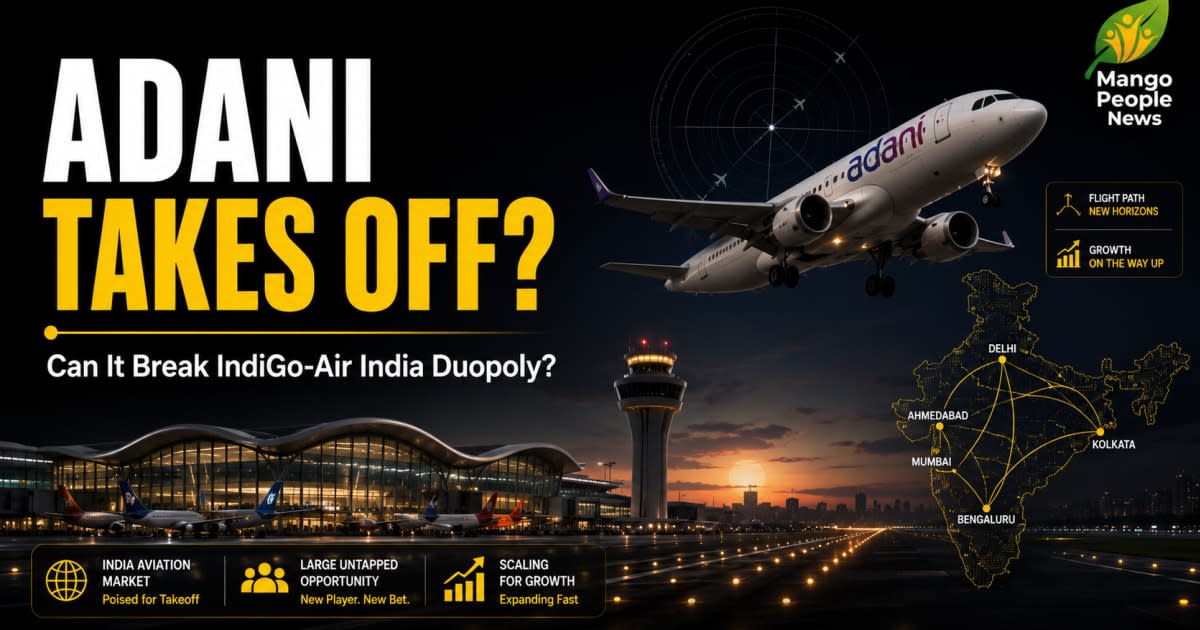
India’s aviation market may be heading toward a notable shift if Adani Group decides to launch an airline or buy into one. The idea is significant not because new airlines are rare, but because the business has a long history of burning capital, squeezing margins and forcing even well-funded players out of the market.
The Adani advantage is obvious on paper: airport control, deep pockets, infrastructure experience and a strong presence across the aviation value chain. But the industry still punishes scale without discipline, and the hardest part of airline ownership is not entering the market — it is surviving it.
Why the idea is back
The renewed talk around Adani’s possible airline move comes as the government is reportedly exploring a rule change that could allow airport operators to own and run airlines. That would matter directly for Adani and GMR, both of which already operate major airport assets in India.
Reuters reported that Adani is considering either launching a new carrier or taking a stake in an existing one, though no final decision has been made and internal discussions are still at an early stage. The group had earlier said it was not looking to enter the airline business, which makes the current discussion a marked strategic change.
Why airlines are such a hard business
Airlines are famous for attracting huge capital and delivering weak returns. Even when traffic grows, profits can evaporate quickly because of fuel costs, aircraft lease payments, maintenance, crew expenses, foreign exchange movement and intense fare competition.
India is especially unforgiving. The market is large and growing, but it is also highly price-sensitive, and low-cost carriers dominate. That means any new entrant must either offer a structural cost advantage or accept a long period of losses before building scale.
The duopoly problem
One reason the government is paying attention is the concentration of market power. IndiGo and Air India together control nearly 90% of domestic capacity, and Indigo alone holds the dominant share.
That kind of concentration creates a strategic opening for a new player, but it also shows why so many challengers have failed. If the market is already controlled by large incumbents with fleet scale, route depth and distribution power, a new carrier needs more than money — it needs a different operating model.
What Adani brings to the table
Adani is not starting from zero. The group already operates eight airports in India and has been building one of the country’s largest private aviation infrastructure platforms. It also has an expansion strategy worth billions of dollars across airport and city-side development.
That gives Adani an important edge over most would-be airline entrants. It controls passenger flow, airport real estate, MRO, JV with Embraer to manufacture commercial planes, commercial spaces and aviation infrastructure, all of which could theoretically support an airline business with better coordination and lower friction than a standalone competitor would have.
Why infrastructure alone may not be enough
Even with airport control, an airline still has to master a difficult set of tasks. It needs aircraft, pilots, slots, maintenance capacity, operations discipline, fuel access, network planning and cost control. None of those problems disappears simply because the parent company owns airports.
There is also a regulatory concern. If an airport operator owns an airline, questions will arise over slot allocation, commercial neutrality and whether competing airlines are being treated fairly. That issue could become especially sensitive at airports where Adani or GMR play a central role.
The government’s possible logic
The reported policy discussion appears to be motivated by a desire to broaden competition. With the top two carriers so dominant, policymakers may be looking for a credible domestic counterweight that can improve choice and reduce concentration risk.
At the same time, there is a public-policy angle beyond competition. Air India’s recent safety and operational scrutiny, along with disruptions at IndiGo, may have encouraged the government to look more seriously at new entrants backed by financially strong groups.
Why failed airlines should be a warning
India has seen several airline models collapse under the weight of debt, aggressive expansion and weak margins. The lesson from those failures is that aviation is not a business where ownership of infrastructure or brand recognition automatically translates into profitability.
The real test is whether a carrier can keep unit costs low, maintain schedule reliability and survive fuel shocks while still offering competitive fares. Many airlines have entered with ambition; far fewer have lasted long enough to matter.
What would make Adani different
If Adani enters, it would likely do so with a long-term strategic lens rather than a short-term passenger-play mindset. The group has already shown that it is willing to build large infrastructure businesses over time, and it has the financial capacity to absorb early losses if needed.
But that still does not guarantee success. Airline economics remain unforgiving, and an airport empire does not automatically translate into an airline advantage unless fleet strategy, network planning and operational excellence are aligned from day one.
The real question
The question is not whether Adani can launch an airline. It probably can, if regulation allows it. The real question is whether it can build a carrier that survives the same structural pressures that have defeated so many others in India.
If Adani enters, the move would likely reshape India’s aviation conversation for years. But success would depend less on the size of the balance sheet and more on whether the company can escape the economics that have trapped the industry for decades.

Nikunjj Jhawar is a Chartered Accountant (CA) and Chartered Financial Analyst (CFA) with nearly two decades of experience in the financial services industry. Having worked with global institutions such as HSBC and Credit Suisse in investment-related roles, he brings deep expertise in finance and markets. He is the Founder of mangopeoplenews.com, where he focuses on making complex topics in finance, markets and business accessible and relevant to everyday readers.