Revenue Is Growing but Profit Isn't: Should Investors Worry?
Open any corporate quarterly earnings release, and the first headline is almost always the same: "Revenue jumps 25% Year-on-Year!"
Retail investors cheer this number, buy the stock on the strength of it, and then wonder why the share price falls the following week. The reason is simple once you see it: a company's value ultimately comes from the cash that flows down to net profit, not from top-line turnover. Revenue tells you how much business a company is doing. Profit tells you how much of that business the company actually gets to keep.
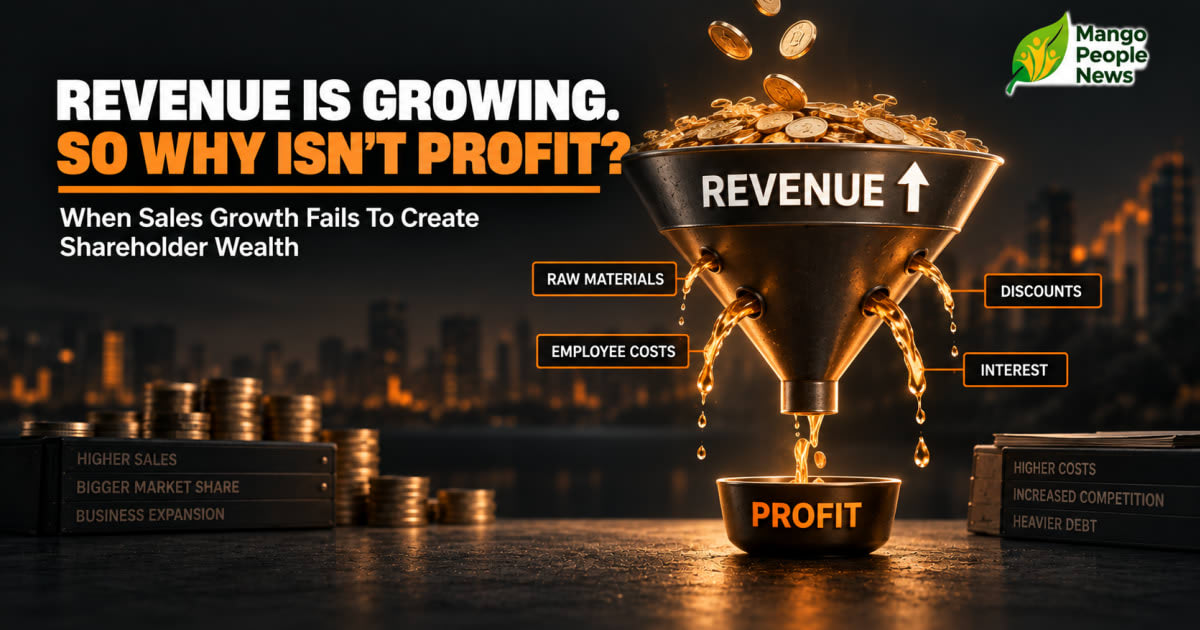
The Leaky Funnel of a P&L Statement
Think of a company's Profit & Loss (P&L) statement as a funnel with several drains along the way. Revenue is simply the gross cash collected from sales — the widest point at the top of the funnel. Before a shareholder sees a single rupee of that money, it has to pass through raw material costs, employee salaries, marketing spend, interest on loans, depreciation on assets, and taxes. What survives all of that, at the very bottom of the funnel, is net profit — the only number that ultimately belongs to shareholders.
If sales grow 20% but operating costs or raw materials surge 35% in the same period, operating profit actually shrinks even as revenue climbs. The company is doing more work, selling more products, running a busier operation — and keeping less money for every rupee of business it does. This is precisely the gap that makes a "25% revenue growth!" headline meaningless on its own.
When Divergence Is a Red Flag
Not every case of "revenue up, profit flat" is identical. Three patterns explain most of them.
1. Raw material inflation with no pricing power.
If an auto manufacturer sells 20% more cars, but steel prices rise sharply and the company cannot raise vehicle prices without losing customers to a competitor, net profit stagnates even as the factory floor gets busier. This is a warning sign about the business itself: a company that can't pass rising costs on to its customers lacks pricing power — the ability to raise prices without losing volume — which is one of the clearest signs of a durable competitive advantage, or the lack of one.
2. Discounting and "buying" growth.
This pattern is common in consumer internet startups and quick-commerce platforms. Steep discounts, cashbacks, and expensive advertising campaigns can make revenue and order volumes climb rapidly, while simultaneously incinerating bottom-line profit. India's own food-delivery and quick-commerce sector is living through exactly this dynamic in real time. In Q1 FY26, Swiggy's net loss nearly doubled year-on-year to ₹1,197 crore even as its business kept expanding, with its Instamart quick-commerce arm alone posting a loss of ₹797 crore — nearly three times the loss from a year earlier — driven directly by aggressive dark-store expansion. Zomato's parent, Eternal, has shown the same pattern from a different angle: even while remaining profitable, its quarterly profit fell nearly 78% at one point as its own quick-commerce arm, Blinkit, spent aggressively opening new stores and offering discounts to fend off competition. In both cases, the growth is real — order volumes and revenue are genuinely rising — but a large share of what customers save through discounts is coming directly out of the company's own bottom line.
3. Bloated debt and interest burdens.
A company might expand revenue by taking on large bank loans to build new factories or acquire capacity. If the interest payments on that debt consume all the operational gains from the expansion, shareholders are left holding a bigger, busier company that generates no additional profit for them — the bank, not the shareholder, is the one actually benefiting from the growth.
When It Is Acceptable Temporarily
Stagnant profit during a phase of revenue expansion isn't automatically a red flag. It can be a deliberate, rational choice — but only under specific conditions. This is acceptable when a company is consciously reinvesting operating cash flow into building physical capacity, entering new export markets, or establishing infrastructure (like Blinkit's or Instamart's dark-store networks) that management genuinely expects will generate outsized profits two to three years down the road.
The distinction that matters here is between a company that is losing money because its business model doesn't work at scale versus one that is losing money on purpose, today, to build a bigger, more profitable business tomorrow. Both look identical on a single quarter's P&L statement — a Rs. X crore loss next to fast-growing revenue. The difference only becomes visible when you track the trend over several years: is the loss narrowing as the company gains scale (a sign the strategy is working), or is it widening or staying flat indefinitely (a sign it may not be)? Swiggy's own Q4 FY26 results offer a useful example of the "working" case — its net loss narrowed nearly 25% quarter-on-quarter even as revenue kept growing, a trend investors watch closely as evidence that the reinvestment phase is beginning to pay off.
What Does It Mean for Me?
Never react to a revenue headline in isolation. Before getting excited about a "25% revenue growth" quarter, check what happened to operating profit and net profit in the same period. A widening gap between the two growth rates is the single most important number the initial headline doesn't tell you.
Distinguish "can't raise prices" from "is discounting on purpose." A company that isn't growing profit because competitors are undercutting it on an essential product has a business-model problem. A company that isn't growing profit because it is deliberately underpricing to acquire market share in a new category is making a strategic bet — track whether that bet is narrowing its losses over successive years, not just this one quarter.
Check the trend across multiple years, not a single quarter. One quarter of profit disappointment during a genuine expansion phase tells you little. Three or four consecutive years of expanding revenue with genuinely flat or declining profit, absent a clear, credible reinvestment story, is where patience should turn into skepticism.
Read the balance sheet alongside the P&L. If profit stagnation is being driven by rising debt and interest costs rather than deliberate operational reinvestment, check whether that debt is funding productive new capacity or simply plugging cash-flow gaps — the two scenarios look similar on the surface but lead to very different outcomes for shareholders.
The One-Line Takeaway
Top line is vanity; bottom line is sanity. If a company cannot eventually turn expanding sales into expanding net profit over a multi-year period — and can't give you a credible, trending explanation for why not yet — that's the signal to walk away, no matter how impressive the revenue headline looks.

Nikunjj Jhawar is a Chartered Accountant (CA) and Chartered Financial Analyst (CFA) with nearly two decades of experience in the financial services industry. Having worked with global institutions such as HSBC and Credit Suisse in investment-related roles, he brings deep expertise in finance and markets. He is the Founder of mangopeoplenews.com, where he focuses on making complex topics in finance, markets and business accessible and relevant to everyday readers.