Free YouTube Videos, Paid Classrooms: Decoding PhysicsWallah's Real Business Model
From "Hello Bacchon" To A Listed Company
For an entire generation of Indian students grinding through JEE and NEET prep, Alakh Pandey's opening line — "Hello bacchon" — became as familiar as any classroom greeting. It started as a one-man YouTube channel, free lectures uploaded for anyone willing to watch. Five years ago, PhysicsWallah wasn't even a company in any meaningful sense. Today, it's India's first new-age edtech startup to go public, pulling in more than ₹1,000 crore in quarterly revenue.
The company's own arc looks even more striking set against what happened to the rest of Indian edtech over the same stretch. BYJU'S collapsed under its own weight. Unacademy ended up folding into upGrad. Vedantu has struggled to scale despite its unicorn tag, even after its founder said the company had reached break-even. PhysicsWallah, meanwhile, kept expanding — into offline centres, into new exam categories, into acquisitions — while staying standing when most of its peers didn't.
That survival story is well told by now. The more interesting question is a quieter one: once a free YouTube viewer becomes a paying student, how exactly does PhysicsWallah make money off them — and how much of that money does it actually get to keep?
The Funnel: From Free Videos To Physical Classrooms
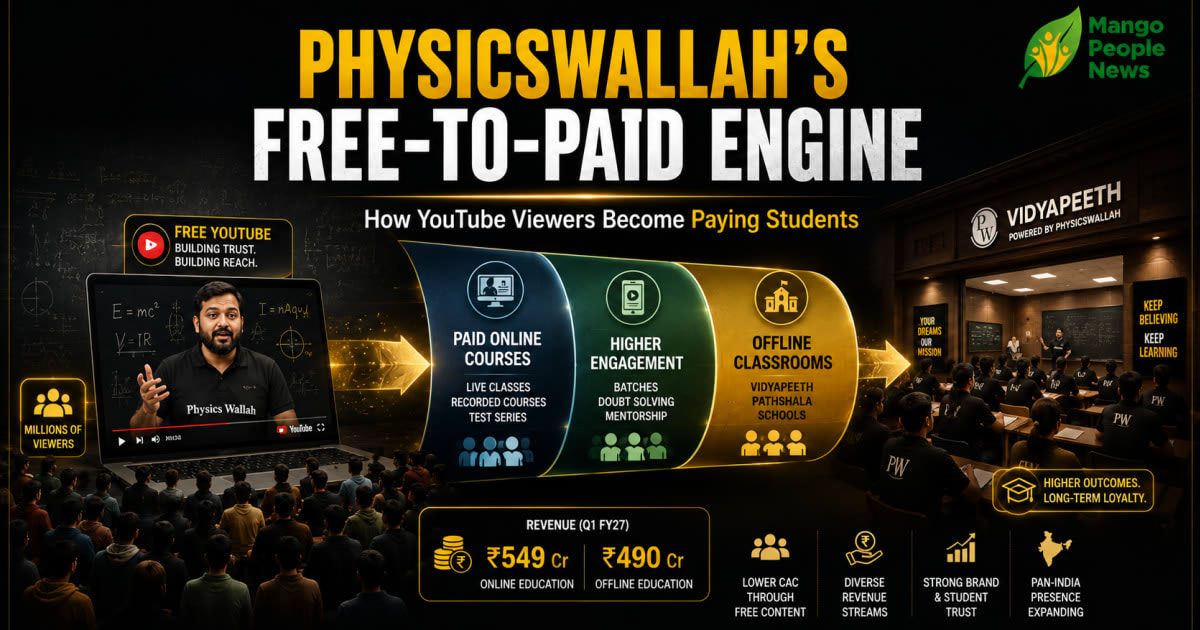
PhysicsWallah's business starts well before anyone pays a rupee. Free YouTube content — and yes, the ad revenue YouTube itself generates from all that "free" viewing — is the entry point, built to pull in a large audience and funnel a portion of it toward paid products.
From there, the paying journey typically moves in stages: first into paid online batches, and increasingly, into physical formats. The company runs two distinct offline models — Pathshala, a hybrid format launched in 2021 that blends online instruction with in-person support, and Vidyapeeth, a fuller offline classroom coaching model launched a year later.
In the June quarter of FY27, this funnel produced ₹1,054 crore in revenue from operations, up more than 24% year-on-year. Online education contributed ₹549 crore of that, offline education brought in ₹490 crore, and the remainder came from the company's smaller "Others" bucket.
Where The Real Money Comes From — And Where It Doesn't Yet
Splitting PhysicsWallah's business into its two core engines makes clear that "growing revenue" and "making money" aren't the same story for this company right now.
Online Education: The Profitable Core
Online remains PhysicsWallah's original and most dependable monetisation engine. The free lectures are the hook, but revenue comes from paid enrolments across JEE, NEET, K-12, government exam prep, professional courses like CA/CS/ACCA/CFA, and a growing skills catalogue. This segment is standalone profitable, posting an operating profit of ₹75.9 crore in Q1 FY27.
Offline Education: Bigger Losses, Bigger Fixed Costs
Offline, in contrast, is a genuinely different kind of business. It generated ₹490 crore in the same quarter — up 14% year-on-year, and now nearly as large as online — but it remained loss-making at the segment level, posting an operating loss of ₹27 crore. Once unallocated corporate costs are factored in under the company's revised allocation method, that loss widens to ₹54 crore in the shareholders' letter. Notably, this is the first quarter PhysicsWallah has broken out segment-level financials this way, with the prior year's Q1 FY26 numbers restated on the same basis for comparison.
The gap makes intuitive sense once you consider what each business actually requires. Online scales through content and technology; offline scales through real estate, faculty and physical infrastructure — costs that show up well before a new centre starts paying for itself.
The Rest Of The Business
Beyond these two engines, PhysicsWallah earns smaller amounts through a B2B business supporting K-12 schools, along with hardware sales and student financing products, all bundled into its "Others" category — worth ₹15.3 crore in operating revenue for the quarter.
Why The Headline Numbers Undersell A More Complicated Story
Revenue growth alone doesn't capture what's really going on inside PhysicsWallah's business, because the way it earns from a student — and how quickly that money actually shows up as recognised revenue — varies a lot depending on the channel.
The company uses two different yardsticks to track this. For online, it looks at ACPU (average collection per user), reflecting the fact that most students pay their full course fee upfront for the year. For offline, it uses ARPU (average revenue per user) instead, since offline revenue gets recognised over the course of the year as students are actively enrolled and taught.
In the June quarter, online ACPU rose 10% year-on-year to ₹4,312, while offline ARPU climbed 7% to ₹12,633 — both fairly modest increases, especially set against online revenue's much stronger 33% overall jump for the quarter.
Why The Growth In These Metrics Looks Muted
Management attributed the softer ACPU and ARPU growth largely to a shift in this year's NEET exam calendar, which moved five to seven weeks later than usual — a timing quirk that delayed both enrolments and collections rather than reflecting any underlying weakness in demand. Company executives noted that collections picked up sharply once NEET results were announced on July 16, with growth of nearly 50% compared to the same post-results period a year earlier.
The company has been fairly direct that these per-user metrics shouldn't be read too literally on a single-quarter basis. Since ACPU's growth trails well behind online revenue's overall growth rate, a meaningful chunk of that revenue increase is coming from acquiring more students and entering new categories — not simply from charging existing students more. Management has repeatedly steered investors toward viewing the business over a full academic year rather than reacting to any one quarter, given how closely enrolment and collection patterns track the exam calendar.
The Spending Side: Betting Mature Businesses Fund Newer Ones
PhysicsWallah isn't really one business — it's several, bundled under a single brand, each with very different economics. Established categories like JEE, NEET, CA and MBA prep are solidly profitable. Newer bets — NEET PG, Skills, Curious Junior, vernacular-language education — are still very much in investment mode. And offline, despite generating almost as much revenue as online, remains a net drag at the segment level.
This mix shapes the company's entire expansion strategy: use the mature, profitable categories to fund newer ones and a more capital-intensive offline footprint. Done well, this widens PhysicsWallah's addressable market and increases how much it can eventually earn from each student over their lifetime with the platform. Done poorly, it risks diluting margins if the newer bets take longer than expected to mature.
There are early signs of cost discipline elsewhere in the business. Management noted that employee costs, excluding ESOP expenses, actually declined 2.6% year-on-year in Q1 FY27, even as marketing spend rose to ₹128 crore from ₹117 crore a year earlier.
The Real Cost Center Is Offline
Where the company's cost structure gets genuinely challenging is in its physical centres. Every new offline location carries a heavier fixed-cost burden than an online course ever would — rent, faculty salaries, infrastructure, and other operating costs that have to be absorbed well before that centre reaches maturity.
PhysicsWallah earmarked ₹1,008.9 crore of its IPO proceeds specifically for offline and hybrid centre expansion and leases. As of June 30, 2026, the company had spent just ₹134.9 crore of that, leaving ₹874 crore still unutilised — suggesting the bulk of this planned offline buildout is still ahead of it, not behind it.
Management has said that mature Vidyapeeth centres can eventually deliver steady-state margins of 13-15%. Put simply: a centre generating ₹10 crore in annual revenue could, once it reaches full scale and utilisation, produce roughly ₹1.3-1.5 crore in operating profit. Getting there depends on two levers in particular — higher ARPU (which risks pricing out some prospective students if pushed too hard) and stronger student outcomes, since results are ultimately what justify the cost of an offline seat and keep enrolments coming. This tension becomes more important as PhysicsWallah tries to shift offline from its original affordability-first positioning into a genuinely profitable growth engine in its own right.
Building A Full-Stack Education Company
PhysicsWallah's ambitions have clearly moved past being "the JEE and NEET company." Its next phase of growth is about capturing multiple stages of a student's educational journey — starting from school-level education all the way through competitive exams, higher education and skilling.
That means pushing the starting point of the relationship much earlier than before. The company's K-12 and early-learning business — spanning foundation and pre-foundation courses, Curious Junior, commerce, and various school board curricula — grew 88% year-on-year in Q1 FY27 to ₹105 crore in revenue, with enrolments up 41% to 7.8 lakh students. PhysicsWallah has also expanded its state board coverage from seven boards to 14.
Acquisitions have played a direct role in widening this footprint. Saarthi IAS added UPSC exam preparation to the portfolio, while Xylem Learning and Utkarsh Classes extended PhysicsWallah's reach across other competitive exams and offline markets. On the product side, the company has rolled out PW Books, a short-term skilling offering called Earners, and a cluster of AI-driven tools — Ask AI, AI Companion and AI Tutor.
The underlying logic is straightforward: the earlier PhysicsWallah enters a student's academic life, the longer it can potentially retain that relationship — from school, through competitive exams, into higher education and eventually skilling. But this expansion also pushes the company into markets with different competitors, different customer expectations, and different unit economics than the ones it built its name on. Whether PhysicsWallah can turn this breadth into a genuinely compounding advantage — rather than a loosely connected collection of separate education businesses — is the question that will likely define its next few years more than any single quarter's revenue number.

Nikunjj Jhawar is a Chartered Accountant (CA) and Chartered Financial Analyst (CFA) with nearly two decades of experience in the financial services industry. Having worked with global institutions such as HSBC and Credit Suisse in investment-related roles, he brings deep expertise in finance and markets. He is the Founder of mangopeoplenews.com, where he focuses on making complex topics in finance, markets and business accessible and relevant to everyday readers.