

Forget Super Apps: AI Agents Could Rewrite India's Digital Economy
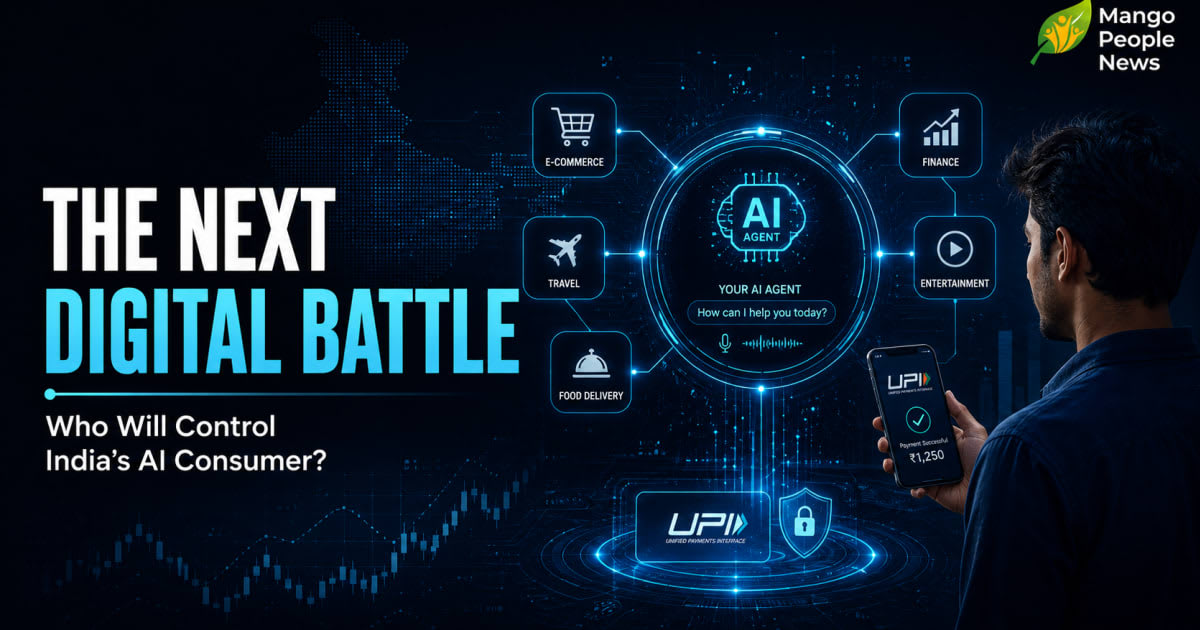
India's first digital revolution was built around apps. There was an app for payments, an app for food, an app for travel, an app for shopping and another for almost every service a consumer needed. Platforms competed fiercely to become the destination where users discovered products and completed transactions.
Artificial intelligence could change that model. The next generation of consumer technology may not ask users to open the right app at all. Instead, an AI agent could understand what a person wants, compare options across services, make recommendations and eventually complete the transaction on the user's behalf.
For India, this transition could be particularly significant. The country already has hundreds of millions of digital consumers, widespread digital payments and interoperable public technology infrastructure. UPI processed 22.71 billion transactions in June 2026, illustrating the scale at which digital transactions already operate in India.
The opportunity, therefore, is not simply to build another AI chatbot. It is to build the AI layer that sits between Indian consumers and the digital economy.
From Apps to Intent: The Consumer Internet Is Changing
The smartphone transformed how Indians access services. A consumer who wanted dinner once had to call a restaurant. Then came food-delivery apps. The consumer no longer needed to know which restaurant to call—the platform handled discovery, comparison, payment and delivery.
AI agents could take this one step further.
Instead of opening a food-delivery app and searching through hundreds of restaurants, a consumer could simply say:
"Find me a healthy dinner for four under ₹1,000 and have it delivered by 8 pm."
The agent could potentially compare restaurants, consider the user's preferences, check delivery times, make the selection and complete the payment.
The interface shifts from navigation to delegation.
That is the fundamental change.
Why India Could Be an Important Consumer-Agent Market
India has several characteristics that could make it unusually fertile ground for consumer AI.
The first is scale.
India is already one of the largest markets for major consumer AI platforms. Industry observers have pointed to India becoming one of the world's biggest consumer-AI markets as adoption accelerates.
The second is digital behaviour.
Indian consumers are already comfortable comparing prices, switching between platforms and searching for the best deal. An agent that performs those tasks automatically could therefore solve a familiar problem rather than introduce an entirely new behaviour.
The third is India's digital infrastructure.
UPI has demonstrated that consumers can rapidly adopt a common transaction layer when the experience is simple and interoperable. The next opportunity could be to build a similarly powerful action layer for AI.
India Doesn't Need Another Super-App
The obvious comparison is with the super-app.
A super-app tries to bring shopping, payments, travel, food, financial services and other activities under one application.
India's consumer internet has generally developed differently. Users often prefer specialised platforms for specific jobs rather than putting everything into one destination. That creates an important opening for agents.
An AI agent does not necessarily need to own the underlying service. It could sit above multiple services.
The Agent Becomes the Consumer's Front Door
Imagine telling an agent:
"Book the cheapest flight that leaves after 7 pm, has one checked bag and arrives before noon."
The agent could potentially search multiple airlines and travel platforms rather than forcing the user to visit each one. The same model could apply to Grocery shopping, Restaurants, Travel, Hotels, Insurance, Personal finance, Utility payments, Healthcare appointments and Household services.
The consumer's relationship shifts from platform loyalty to agent loyalty.
The Biggest Change Could Be in Commerce
The impact on ecommerce could be particularly dramatic.
Today, online retailers spend enormous amounts of money trying to win attention through advertising, search rankings, discounts, influencers and recommendations.
An agent changes the economics.
If consumers delegate product discovery to an AI assistant, brands may no longer compete primarily for the customer's eyeballs. They may compete for the agent's recommendation.
That means product information, price, availability, reviews, delivery reliability and brand reputation could become machine-readable competitive assets.
McKinsey describes agentic commerce as a model in which AI agents can discover products, compare options, negotiate and execute transactions on behalf of consumers. This could eventually make the traditional ecommerce funnel look very different.
The New Battle Will Be Over Trust
But there is a major obstacle. Consumers may be comfortable asking AI questions. They may not be equally comfortable allowing it to spend their money. There is an enormous difference between:
"Which laptop should I buy?"
and
"Buy the laptop for me."
The second requires the agent to understand preferences, budget, risk tolerance and authority.
Research and industry commentary increasingly identify trust as one of the biggest barriers to agentic commerce adoption. Consumers need confidence that an agent will not make an incorrect purchase, choose a poor-value product or expose sensitive information.
The winning consumer agents will therefore need something more valuable than intelligence.
They will need trust.
The Data Advantage Could Become Enormous
A conventional search engine knows what a user searched for. A consumer agent could potentially know much more. It could understand:
What the user regularly buys
How much they usually spend
Which brands they prefer
What they reject
Where they live
What their household needs
Which subscriptions they maintain
What they are planning
That context can make recommendations dramatically better. But it also creates an important question:
Who owns the consumer's intent?
If the agent knows that a consumer is looking for a new car, a holiday or a home loan before the merchant knows, that information itself becomes economically valuable.
The consumer-agent relationship could therefore become one of the most important data and privacy relationships in the digital economy.
India's Digital Public Infrastructure Could Become a Strategic Advantage
India's experience with digital public infrastructure offers an important lesson.
UPI did not need to become another closed wallet competing with every bank. Instead, it created an interoperable payment layer that allowed different participants to connect.
A similar philosophy could matter for AI agents.
Rather than building one giant Indian agent that controls every transaction, India could benefit from open standards that allow:
Consumer Agent → Discovery → Merchant → Payment → Fulfilment
to work across different platforms.
That could create an ecosystem in which thousands of specialised agents and businesses interact without requiring consumers to maintain dozens of separate integrations.
The technology behind agentic commerce is already moving in this direction globally, with protocols designed to allow AI systems to interact with merchants and complete purchases.
The Opportunity Is Bigger Than Shopping
It would be a mistake to reduce consumer agents to ecommerce. Some of India's biggest consumer problems involve navigating complexity.
Finding a suitable insurance policy, understanding a government process, comparing financial products, scheduling healthcare, planning travel or managing household services can involve multiple steps and fragmented information.
An intelligent agent could potentially absorb that complexity. This is particularly relevant in India because the country has historically relied on human intermediaries to navigate complicated systems.
The digital agent could become the software equivalent of that trusted intermediary—but available at near-zero marginal cost and at much greater scale.
Who Could Win the Consumer-Agent Race?
The winner may not necessarily be the company with the largest AI model. The underlying model is increasingly becoming a commodity layer. The more defensible assets could sit elsewhere.
Distribution
The agent must exist where consumers already spend time—on phones, search, messaging platforms, browsers and payment interfaces.
Context
It must understand the Indian consumer better than a generic global assistant.
Trust
Consumers must be willing to give it permission to act.
Transaction Infrastructure
It needs reliable access to payments, commerce and service providers.
Specialised Knowledge
A travel agent, financial agent or healthcare agent may ultimately outperform a generic assistant in its specific domain.
The strongest businesses could therefore be built on top of foundation models rather than competing directly with them.
The Risk: India Could Become an Agent Economy Without Indian Winners
There is also a strategic risk. India could become one of the world's largest markets for consumer agents without producing many of the companies that control the technology.
Global AI companies already have enormous advantages in models, computing, distribution and capital. Indian startups therefore need to identify where local knowledge creates a genuine advantage.
That could include vernacular voice interaction, local commerce, Indian payments, financial services, fragmented service markets and the unique behaviour of India's price-sensitive consumers.
The opportunity is not necessarily to build the world's biggest AI model. It is to build the best AI businesses for India's consumers.
What the Next Five Years Could Look Like
The transition will probably happen gradually.
First, agents will recommend.
Then they will compare.
Then they will complete simple transactions.
Eventually, consumers may delegate recurring decisions entirely.
Imagine an agent that automatically:
Reorders household essentials.
Finds cheaper insurance at renewal.
Books travel according to a predefined budget.
Pays recurring bills.
Searches for better financial products.
Schedules household services.
At that point, the consumer internet changes fundamentally. The user no longer spends time navigating digital services.
The agent does the navigation.
The Bottom Line
The consumer-agent opportunity is not simply about replacing search boxes or chatbots. It represents a possible restructuring of India's digital economy—from a world where consumers navigate dozens of apps to one where AI systems understand intent and coordinate actions across them.
India has an unusual combination of ingredients: a massive digital consumer base, rapidly growing AI adoption, sophisticated digital payments and public technology infrastructure.
The biggest question is therefore not whether Indians will use AI.
It is who will become the trusted agent through which Indians make decisions, discover products and spend their money.
That could be one of the defining technology battles of the next decade.

Nikunjj Jhawar is a Chartered Accountant (CA) and Chartered Financial Analyst (CFA) with nearly two decades of experience in the financial services industry. Having worked with global institutions such as HSBC and Credit Suisse in investment-related roles, he brings deep expertise in finance and markets. He is the Founder of mangopeoplenews.com, where he focuses on making complex topics in finance, markets and business accessible and relevant to everyday readers.


