Beyond The Founders: Why Motilal Oswal's Succession Plan And 10X Profit Vision Could Shape Its Next Decade

A chance encounter on a motorcycle in the mid-1980s laid the foundation for one of India's most resilient financial empires. Nearly four decades later, billionaires Motilal Oswal and Raamdeo Agrawal are executing a highly strategic, two-pronged transition at Motilal Oswal Financial Services Ltd (MOFSL): passing the operational baton to the next generation while chasing a monumental tenfold growth in bottom-line profits over the next ten years.
In a comprehensive dialogue charting the future of the ₹60,000-crore financial powerhouse, 64-year-old co-founder Motilal Oswal detailed how the firm is institutionalizing its governance, expanding the roles of its core professional leaders, and anchoring its future in the compounding growth of India's domestic wealth.
The 39-Year Partnership: Trust as a Structural Advantage
The operational foundation of this vast financial network remains the enduring 39-year professional relationship between Motilal Oswal and Raamdeo Agrawal.
Having lived in the same Rajasthan-sponsored student hostel in Mumbai during their Chartered Accountancy days without ever crossing paths, the two finally connected in 1986. The partnership began informally when Oswal started hitching rides home from the Bombay Stock Exchange (BSE) on the back of Agrawal’s Hero Honda motorcycle. By 1987, they formally launched their business.
Because early exchange regulations prohibited corporate partnerships from owning trading cards, the initial BSE card was registered solely in Oswal's name, leaving Agrawal to operate formally as a "consultant" for the first six years—a arrangement built entirely on mutual trust.
Their roles have remained strictly complementary: Oswal manages corporate execution, scale, and day-to-day operations, while Agrawal drives the investment research engine and guides client advisory strategies. Perhaps the ultimate testament to this division of labor lies in how the co-founders manage their own personal finances: Raamdeo Agrawal directly manages Motilal Oswal’s personal investment portfolio.
The Next-Gen Succession: Structured Board Entry
As part of a deliberate governance strategy, the co-founders have formally inducted their sons onto the MOFSL board, providing a direct runway for the family's second generation to absorb the group’s overarching operational philosophy.
Pratik Oswal (38): Currently anchors the firm's passive and quantitative investment wings within the Asset Management business.
Vaibhav Agrawal (37): Manages an asset pool exceeding ₹36,000 crore, overseeing the group's highly lucrative Alternate Investment Fund (AIF) and Portfolio Management Services (PMS) platforms.
Despite their elevation to the board, Motilal Oswal emphasizes that institutional meritocracy will dictate the long-term leadership framework. The next-gen executives currently operate within the company's professional architecture, reporting directly to their respective business unit CEOs.
"We have brought them onto the board because proactive succession is absolutely critical to long-term stability," Oswal noted. However, he remained clear that their future leadership trajectory will rely heavily on their own evolution and choices, maintaining flexibility between active day-to-day governance or stepping into non-executive promoter oversight.
The Professional Backbone: Empowering 'Promoter-Equivalents'
A crucial element of the MOFSL transition strategy is the deep integration of professional corporate managers into ownership-level responsibilities. The primary example of this approach is Group Managing Director Navin Agarwal.
Though a professional manager rather than a family member, Agarwal has been positioned as a "promoter-equivalent" within the system. Backed by an equity stake of approximately 5% to 6% accumulated through Employee Stock Ownership Plans (ESOPs), Agarwal stands as the third-largest shareholder in the company. This deliberate blurring of the line between traditional promoter families and professional C-suite executives is designed to give the firm a distinct competitive advantage as it scales.
The "Desi Berkshire" Playbook: A ₹9,400-Crore Engine
A core financial pillar driving the firm's rapid expansion is its massive corporate treasury, which now holds approximately ₹9,400 crore.
Taking visual cues from Warren Buffett’s capital allocation strategy at Berkshire Hathaway, MOFSL avoids distributing all excess operational cash flow. Instead, the firm routes its profits directly back into its own underlying investment funds and long-term equity allocations. This structure turns the corporate balance sheet into a self-compounding asset engine that stabilizes earnings during cyclical market downturns and provides immediate internal capital to scale new business lines. Today, the group operates a diversified financial services model spanning seven distinct business verticals:
Retail and Institutional Broking
Asset Management (AMC)
Wealth Management
Investment Banking
Private Equity
Housing Finance
Corporate Treasury Operations
Cumulatively, the firm now manages or advises a massive client asset pool of nearly ₹7 lakh crore.
The 10X Equation: The Macro Math Behind the Target
While managing internal leadership changes, MOFSL has committed to a highly ambitious financial objective: multiplying its net profits by 10x over the coming decade.
For FY26, the group reported total revenues of ₹9,416 crore and a net profit after tax (PAT) of ₹1,869 crore. To achieve a 10x surge, the firm is targeting a sustainable Compounded Annual Growth Rate (CAGR) of 25% for the next ten years.
While a 25% annualized profit expansion target appears steep, the firm's historical data suggests it is achievable. Over the preceding ten years, MOFSL generated a 33% annual profit growth rate, effectively expanding its bottom line fifteenfold. Over a broader twenty-year arc, the group has clocked a 24% CAGR in revenue and a 28% CAGR in PAT.
Oswal’s macroeconomic thesis centers on financialization tailwinds: historical data shows that Indian capital markets expand at roughly 1.5 to 2 times the rate of nominal GDP. Over the past decade, the benchmark Nifty index delivered earnings growth of 12% to 13%, while MOFSL outpaced the index by growing its bottom line at roughly double that rate (26% to 27%).
Risks Investors Should Watch
Despite favourable long-term trends, several challenges remain. Key risks include:
Cyclical capital markets.
Slower retail trading activity.
Margin pressure.
Competition from fintech platforms.
Regulatory changes.
Talent retention.
Execution of succession plans.
Successfully navigating these risks will determine whether the company can achieve its ambitious long-term objectives.
The Bottom Line
Motilal Oswal Financial Services has reached a defining stage in its evolution. After spending nearly four decades building a respected financial institution, the focus is now shifting from entrepreneurial leadership to institutional continuity.
The ambition to grow profits tenfold over the next decade reflects confidence in India's expanding financial markets and the long-term trend of household savings moving towards investment products.
However, achieving that vision will require more than favourable market conditions. It will depend on successful leadership transition, disciplined capital allocation and the ability to preserve the culture established by Motilal Oswal and Raamdeo Agrawal while adapting to an increasingly competitive financial landscape.
If the company succeeds, its next chapter may be remembered not only for strong financial performance but also for demonstrating how a founder-led enterprise can evolve into a lasting financial institution.
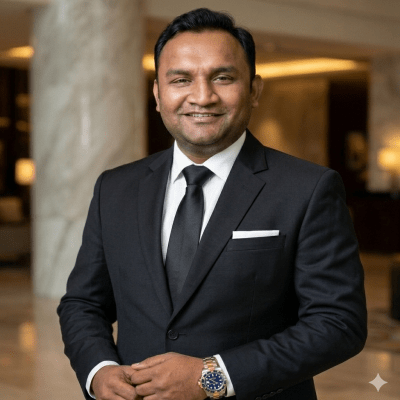
Nikunjj Jhawar is a Chartered Accountant (CA) and Chartered Financial Analyst (CFA) with nearly two decades of experience in the financial services industry. Having worked with global institutions such as HSBC and Credit Suisse in investment-related roles, he brings deep expertise in finance and markets. He is the Founder of mangopeoplenews.com, where he focuses on making complex topics in finance, markets and business accessible and relevant to everyday readers.